
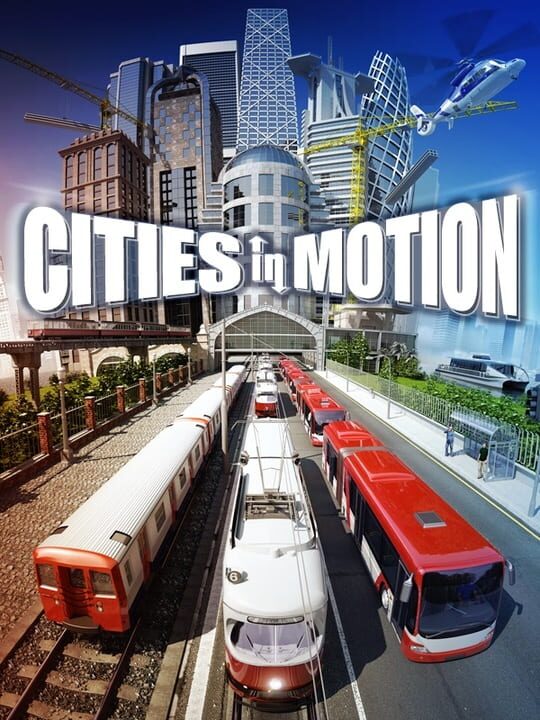
Cities in Motion
Main Game
RELEASED
6.9
Feb 22, 2011
LinuxPC (Microsoft Windows)+1byColossal Order•Paradox Interactive
Overview:|
As a main game strategy simulator released in 2011, Cities in Motion tasks you with managing the complete mass transportation network across four major European cities (Vienna, Helsinki, Berlin, Amsterdam) from 1920 to 2020. Your core loop involves designing routes for buses, trams, and subways to meet evolving commuter needs while ensuring profitability. Its distinctive feature is the century-long historical progression, forcing adaptation to new technology and urban sprawl. The game is available on PC, Mac, and Linux, supported by numerous DLCs.
This is a detailed mass transportation simulation game that places players in the role of a city planner tasked with managing the complex transit needs of major metropolitan areas. Set across a century of development, the core objective is to establish, maintain, and optimize public transport networks to serve the evolving demands of the populace, all while balancing operational costs against revenue generation. The game features four historically rich European cities—Vienna, Helsinki, Berlin, and Amsterdam—each presenting unique geographical and demographic challenges.
Core Gameplay and Setting
The simulation spans the years 1920 through 2020, requiring players to adapt their strategies as technology, city layouts, and commuter behavior shift over nine decades. Players must design routes and manage fleets consisting of various vehicle types, including buses, trams, subway trains, and potentially other modes depending on technological unlocks. Success hinges on creating efficient connections that minimize passenger wait times and maximize ridership across the urban landscape.
The Transportation Network Challenge
The primary mechanic involves laying down routes, purchasing vehicles, setting timetables, and monitoring passenger flow in real-time. Each vehicle type has specific operational requirements, maintenance costs, and capacity limits. A key element is understanding the needs of different demographic groups within the city—workers, tourists, and residents—who travel for distinct reasons and at different times of the day.
What makes this game unique in its genre?
The game distinguishes itself through its deep historical scope and focus on the evolution of urban transit infrastructure over a full century. Players are not just building a static network; they are managing a dynamic system that must continually adapt to technological advancements and urban sprawl. Furthermore, the game emphasizes financial viability; inefficient routes lead to losses, requiring careful budgeting and strategic investment in newer, more capable transit technologies as they become available across the timeline.
Key Features
- Historical Progression: Experience the evolution of public transport from early 20th-century vehicles to modern systems.
- Four Distinct Cities: Manage unique challenges presented by Vienna, Helsinki, Berlin, and Amsterdam.
- Comprehensive Vehicle Management: Oversee a wide array of vehicles, including road, rail, and underground options.
- Financial Balancing: Maintain profitability by optimizing routes, fares, and vehicle deployment against operational expenses.
Game Information Summary
This title is a Main Game simulation released on February 22, 2011. It is available for PC (Microsoft Windows), Linux, and Mac platforms. The game falls under the Strategy and Simulator genres.
What additional content is available?
Since its initial release, the game has received significant support in the form of downloadable content. There are currently 12 DLCs available, offering new scenarios, vehicles, and potentially new city maps to expand the core simulation experience. There are no official expansions or remakes of the main game currently noted.
Game Details
Primary Name: Cities in Motion
Alternative Names:
Cities In Motion.exe (Windows Executable)
Type: Main Game
Series: Cities in Motion
Developer: Colossal Order
Publisher: Paradox Interactive
Release Information
Release Date: Feb 22, 2011
Genres & Themes
Genres: Simulator, Strategy
Themes: Business
Platforms
LinuxPC (Microsoft Windows)Mac
Game Modes
Perspective: Bird view / Isometric
Player Modes: Single-player
Game Modes: Single player
Age Ratings
ESRB:E (Everyone)
PEGI:3+
USK:0 (All Ages)

 Soren
Soren