
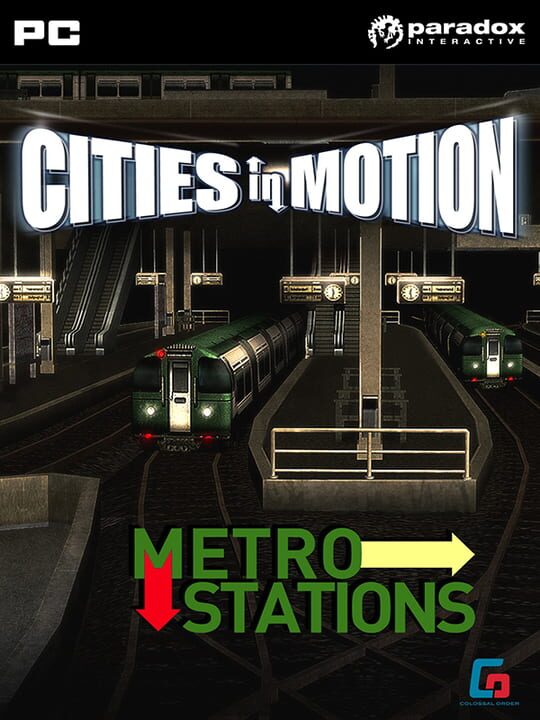
Cities in Motion: Metro Stations
DLC
RELEASED
Jul 23, 2011
PC (Microsoft Windows)byColossal Order•Paradox Interactive
Part of: Cities in Motion
Overview:|
This is a DLC for the 2011 PC simulator, Cities in Motion, enhancing city transit management across 1920–2020. It requires the base game and adds no new vehicles or scenarios, focusing solely on advanced subway infrastructure. Key additions are the Crossed Platform Station (vertical line transfer) and the Multiplatform Station (horizontal, same-level transfer), providing planners with new tools to optimize underground passenger flow and efficiency in dense networks.
This content is an add-on for the core mass transportation simulation experience found in the base game, released in 2011 for PC (Microsoft Windows). It focuses on enhancing the infrastructure management aspect of overseeing public transit networks across detailed, historical cityscapes, spanning the years 1920 through 2020. The primary goal remains maximizing commuter satisfaction and operational profits by strategically deploying and managing various transit modes, including buses, trams, and subways.
Integration and Scope as Downloadable Content
As a Downloadable Content (DLC) package, this material requires the presence of the main Cities in Motion game to function. It does not introduce a standalone experience but rather deepens the existing simulation framework. While the base game provides the comprehensive century-long challenge of urban transit planning, this specific addition focuses narrowly on improving the efficiency and design possibilities of subway connections. It does not introduce new scenarios, time periods, or vehicle types, but rather new architectural components for existing subway lines.
Introducing Advanced Subway Station Designs
The core appeal of this DLC lies in the introduction of two specialized station types designed to streamline passenger flow and connectivity within underground networks. These additions directly impact route planning and station placement decisions for players managing complex, multi-line systems.
Crossed Platform Station
This station type allows for the vertical integration of two distinct subway lines. Passengers can transfer between these two lines without needing to ascend to street level. The design facilitates a smoother, faster transition by stacking the lines, which is crucial for high-traffic interchanges where minimizing transfer time is essential for commuter happiness.
Multiplatform Station
The Multiplatform Station offers an alternative layout where two lines connect horizontally. This station design features four platforms situated adjacent to one another on the same level. Similar to the crossed design, it enables seamless transfers between the two connected lines entirely underground, avoiding surface congestion.
What makes these new station types essential for subway planners?
The inclusion of these station types directly addresses complex logistical challenges inherent in multi-line subway systems. By offering dedicated, level-specific transfer hubs, players gain new tools to optimize route efficiency, particularly in dense urban cores where surface access is limited or where minimizing passenger walking distance between lines is paramount to maintaining high service quality across the 1920–2020 timeline. This content is purely structural, enhancing the building and layout capabilities within the existing simulation engine.
Platform and Release Details
This content was made available on July 23, 2011, exclusively for the PC platform running Microsoft Windows. It is an infrastructure-focused addition and does not include any further expansions or remasters beyond its initial release.
Game Details
Primary Name: Cities in Motion: Metro Stations
Type: DLC
Part of: Cities in Motion
Developer: Colossal Order
Publisher: Paradox Interactive
Release Information
Release Date: Jul 23, 2011
Genres & Themes
Genres: Simulator
Themes: Business
Platforms
PC (Microsoft Windows)
Game Modes
Perspective: Bird view / Isometric
Player Modes: Single-player
Game Modes: Single player
Videos
No videos available for this game.
 Soren
Soren