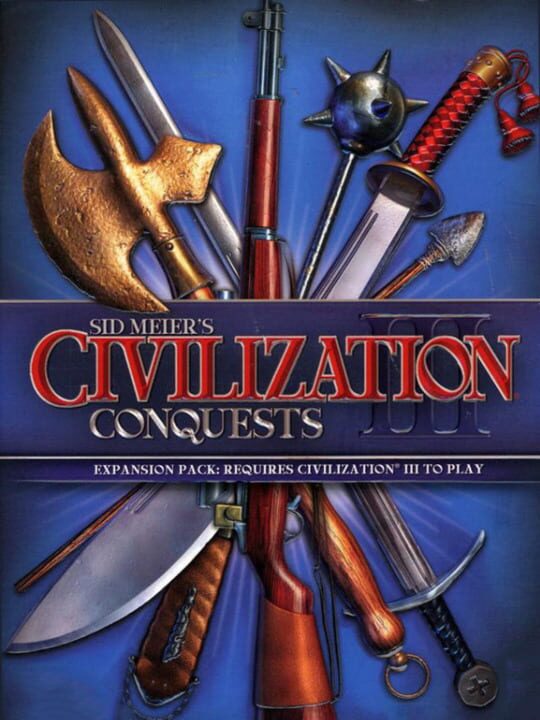
Sid Meier's Civilization III: Conquests
Expansion
RELEASED
7.4
Nov 4, 2003
PC (Microsoft Windows)byBreakAway Games•Atari, Inc.
Part of: Sid Meier's Civilization III
Overview:|
This 2003 expansion for Civilization III deepens the turn-based strategy core by adding eight new civilizations, bringing the total playable count to thirty-one. Gameplay is enhanced with two new government types (Feudalism and Fascism), new Wonders, and two new civilization traits (seafaring and agricultural). The world map features new resources and terrain, including hazardous volcanoes and disease-prone marshes. Its centerpiece is the introduction of focused historical scenarios, offering shorter, alternative challenges that integrate directly with the base game experience.
This is the second and final expansion pack for the critically acclaimed turn-based strategy title, Sid Meier's Civilization III. Released in 2003 for PC (Microsoft Windows), this content significantly deepens the core experience by adding substantial new civilizations, gameplay mechanics, and focused historical challenges. It requires the base game to play, integrating seamlessly to expand the existing strategic framework rather than offering a standalone experience.
What New Content Does This Expansion Introduce?
This expansion pack dramatically increases the variety available to players looking to guide their civilization from antiquity to the modern age. The total number of playable cultures is boosted to thirty-one with the addition of eight new civilizations, including the Byzantines, Dutch, Hittites, Incans, Mayans, Portuguese, and Sumerians.Expanded Civilization Customization
To support these new cultures and refine existing ones, two new special traits have been implemented: seafaring and agricultural. These traits are leveraged by the new civilizations—for example, the Sumerians are designated as Scientific and Agricultural—while some original civilizations have been updated to better reflect historical strengths.
Furthermore, the political landscape is broadened with the introduction of two new forms of government: Feudalism and Fascism. Players can also strive to build new Wonders of the World, such as the Statue of Zeus and the Mausoleum of Mausollos.
New Environmental and Resource Layers
The world map itself receives additions that alter strategic considerations for city placement and resource management.New Resources and Terrain
Four new bonus resources have been added, two of which offer food bonuses to previously less desirable terrain types. These include Oases in deserts, tropical fruit in jungles, sugar on plains and hills, and tobacco on grasslands and hills.
Two new terrain types are also present: marshes and volcanoes. Cities cannot be founded on marshes, and citizens working a marsh tile risk disease. Volcanoes present a dynamic hazard, capable of erupting periodically to destroy adjacent improvements, cities, and units.
The Focus on Historical Scenarios
The centerpiece of this expansion is the inclusion of several new historical scenarios. Unlike the main, long-form "epic" game, these scenarios are designed to be shorter and focus intensely on specific periods of history. This offers players alternative, time-constrained strategic challenges, often optimized for multiplayer engagement.Game Details
- Game Type: Expansion Pack (Requires base game)
- Release Year: 2003
- Platform: PC (Microsoft Windows)
- Genres: Simulator, Strategy, Turn-based strategy (TBS)
This content is generally regarded as a substantial enhancement to the original game, adding significant replayability through its diverse new cultures and focused scenario modes.
Game Details
Primary Name: Sid Meier's Civilization III: Conquests
Alternative Names:
Civilization 3: Conquests (Other)
Civ3:conquests (Other Alias)
civ3c (Other Alias)
Civ III: Conquests (Other Alias)
Civ 3: Conquests (Other Alias)
Type: Expansion
Part of: Sid Meier's Civilization III
Series: Civilization
Developer: BreakAway Games, Firaxis Games
Publisher: Atari, Inc.
Release Information
Release Date: Nov 4, 2003
Genres & Themes
Genres: Simulator, Strategy, Turn-based strategy (TBS)
Themes: Educational, 4X (explore, expand, exploit, and exterminate), Fantasy, Historical
Platforms
PC (Microsoft Windows)
Game Modes
Perspective: Bird view / Isometric
Player Modes: Single-player
Game Modes: Single player, Multiplayer
Age Ratings
ESRB:E (Everyone)
Videos
No videos available for this game.
 Soren
Soren