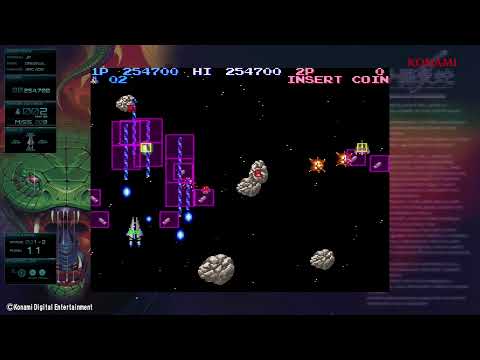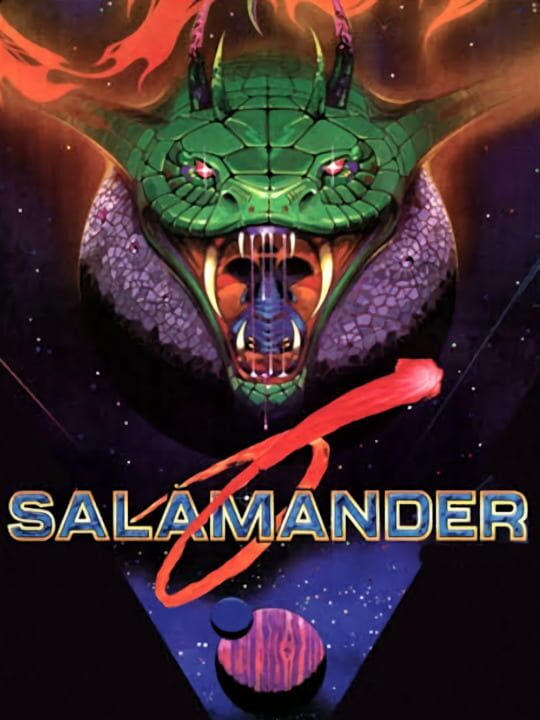
Salamander is a classic 1986 arcade shooter where you pilot a ship through intense aerial combat. The core gameplay loop involves mastering stages that dynamically switch between horizontal and vertical scrolling perspectives. Distinctive features include a simplified power-up system and integrated two-player cooperative play, mechanics that influenced later titles in the genre.
This is a classic arcade shooter that first launched in 1986, bringing fast-paced action to platforms like the Sharp X68000 and arcade cabinets. As a main game in the shooter genre, it delivers intense, high-stakes aerial combat across varied environments.
The central experience revolves around piloting a highly customizable spacecraft through waves of enemy forces. Players navigate stages that dynamically shift between horizontal and vertical scrolling perspectives, demanding constant adaptation in movement and strategy.
A defining feature of this title is its approach to power-ups. Compared to other games in the genre, it features a simplified power-up system, streamlining the process of enhancing your ship's capabilities while maintaining depth in combat.
A significant element of the gameplay is the inclusion of two-player cooperative gameplay. This allows two pilots to team up simultaneously, coordinating attacks and defenses against the relentless enemy onslaught, adding a layer of teamwork to the arcade challenge.
The game is structured around distinct stages that alternate their scrolling direction. This design choice ensures that players cannot rely on a single pattern of movement, forcing them to master both side-scrolling maneuvers and vertical ascent/descent patterns.
As a main arcade title released in 1986, this game remains focused on its core experience. There are currently no downloadable content packs or expansions associated with this release.
Many of the mechanical innovations introduced here, particularly the alternating scrolling stages and the streamlined power-up structure, later became foundational elements adopted by subsequent entries in related shooter franchises.


A version for the PC Engine was released on December 6, 1991. Based on the arcade version of Salamander, changes on this port include starting from a pre-defined checkpoint upon death in 1 Player mode, faster enemy animations, and improved music.


In a distant part of the universe, an alien creature called Zelos was born. As he grew so did his appetite, and soon he began devouring galaxies, planets, and stars by the hundreds. Now your planet has appeared in Zelos' path, and it is up to you and a partner to fly into battle to save your world. Salamander is an action-packed shooter where there are six levels which alternate between side and vertical scrolling, each of them ending with a powerful guardian. Throughout the game, destroying certain enemies will release power ups which can be used to equip your ship with more powerful weapons, extra speed, and shields. Gameplay is for one player or two players simultaneously.


The MSX port of Salamander (沙羅曼蛇, Saramanda) is significantly different from the original and any other ports. New to this port is a graphical introduction that introduces human pilots for each ship, as well as names for each stage. The levels are notably longer than the arcade original, and the player is forced to start from a pre-defined checkpoint upon death of either pilot, instead of starting where he left off. After level two, the player can choose the order of the next three stages. In addition, the player can collect "E" capsules by destroying certain enemies. Collecting fifteen will permanently upgrade one of the available weapons on the power-up bar. Some weapons allow the player ships to merge, one player controlling movements and the second player controlling weapons. Instead of the Vic Viper and the Lord British Space Destroyer, the ships are known as the Sabel Tiger and the Thrasher; piloted by human characters named Iggy Rock and Zowie Scott. The story takes place in the year 6709 A.D and has 2 different endings. The MSX version was re-released for the Wii's Virtual Console in Japan on January 12, 2010. It was later released for the Wii U's Virtual Console on July 20, 2016. They were also made available for the Project EGG on Windows Store on May 19, 2015.

Salamander was ported to the Family Computer in Japan in 1987. Instead of being a direct port of Salamander, elements were taken from the original Salamander and the Japanese Life Force re-release, and some elements, such as levels and bosses, were removed to make way for new content. Most of the background graphics and enemy sprites from Salamander are used in favor of those used in Life Force, though the Gradius-style power bar is used in place of the original instant pick-up system. The same year, North America received a port as well for the Nintendo Entertainment System. The NES version is practically identical to its Famicom equivalent, other than not having the multiple endings, having two option power ups instead of three, and being titled Life Force.

The Japanese and European versions are nearly identical, but the American version changes the game's plot by adding an opening text that establishes the game to be set inside a giant alien life-form which is infected by a strain of bacteria. Stages that feature starfield backgrounds were changed to the web background from Stage 1 to maintain consistency with the organic setting of the plot. The power-ups are also given different names, with the "Speed-Up" becoming "Hyper Speed", the "Missile" becoming the "Destruct Missile", the "Ripple Laser" becoming the "Pulse Laser" and "Force Field" becoming the "Shield". Narration is added to the beginning of each stage, detailing the area of the alien's body which the player is currently inhabiting such as "Enter stomach muscle zone" or "Bio-mechanical brain attack".