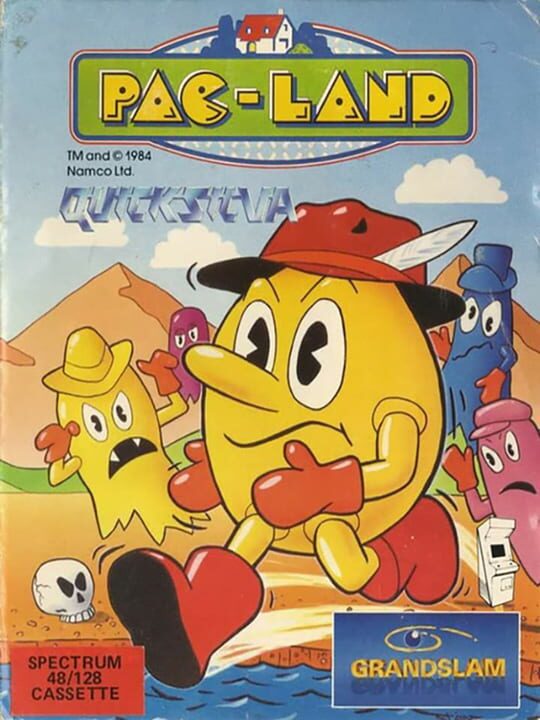
Pac-Land
Overview:|
Pac-Land is an arcade-style platformer port released in 1988 for the Amstrad CPC, focusing on continuous side-scrolling movement. The core gameplay requires players to master precise timing to jump over obstacles and hazards while maintaining forward momentum through various stages. As a port, this version adapts the original coin-op experience to the capabilities of the home computer system, offering fans a faithful translation of its reflex-based challenge.
This title is a Port, specifically an adaptation of the original arcade experience brought to the Amstrad CPC platform, released in 1988. As a port, its core value proposition is translating the established mechanics and visual style of its source material onto this specific 8-bit home computer hardware. The game resides within the Platform and Arcade genres, suggesting a design focused on continuous forward movement, obstacle navigation, and achieving high scores.
Core Gameplay and Setting
The gameplay centers on guiding the main character through side-scrolling stages that demand precise timing. Players must maintain forward momentum while reacting instantly to environmental hazards, gaps, and obstacles that require jumping. The experience relies heavily on pattern recognition and reflex-based action, characteristic of classic arcade design.
The primary objective is survival and progression. Success is measured by the player's ability to navigate the terrain without failure, utilizing well-timed jumps to clear barriers and maintain the necessary pace to complete each segment.
What defines the experience on the Amstrad CPC?
This version represents a technical translation of the original concept to the Amstrad CPC's capabilities. The focus for this specific release, handled by companies including Quicksilva and published by Grandslam Entertainments, was to capture the essence of the arcade challenge within the hardware limitations of the home system prevalent in the late 1980s. As a standalone release for this platform, the content provided at launch is the complete experience offered.
Release Context
This specific iteration of the game was made available on December 31, 1988. It is important to note that this is a version of an existing title, not a new entry in the series.
What is the fundamental challenge of this platformer?
The fundamental challenge involves mastering the continuous forward motion inherent in the design. Players must execute precise movements—primarily jumping—to avoid contact with hazards that terminate the run, making consistent timing the most critical skill required for advancement.
Game Details
Release Information
Release Date: Dec 31, 1988
Genres & Themes
Genres: Platform, Arcade
Themes: Action, Fantasy
Platforms
Amstrad CPC
Game Modes
Perspective: Side view
Player Modes: Single-player
Game Modes: Single player
Videos
No videos available for this game.
 Soren
Soren