
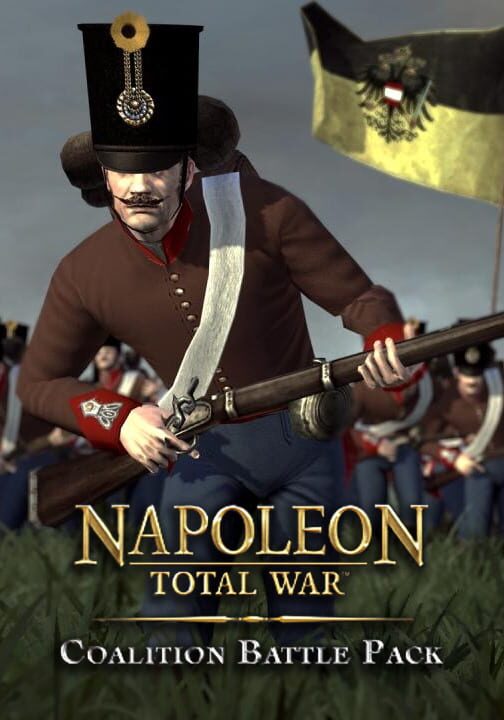
Napoleon: Total War - Coalition Battle Pack
DLC
RELEASED
May 5, 2010
PC (Microsoft Windows)MacbyThe Creative Assembly•Sega
Part of: Napoleon: Total War
Overview:|
The Napoleon: Total War - Coalition Battle Pack is a DLC expansion for the core strategy game, requiring the base title to play. Released in 2010, this pack enhances tactical gameplay by adding the historical Battle of Friedland (June 14, 1807) as a new scenario. It also integrates six new elite military units—such as the Coldstream Guards and Lifeguard Hussars—into the existing roster, offering players fresh tactical options for use in campaigns and custom battles within the Napoleonic Wars setting.
This downloadable content package serves as an expansion for the core strategy title, Napoleon: Total War, available on PC and Mac platforms. It focuses on adding specific historical content and new military assets to the existing grand strategy framework, requiring the base game to access its features. This pack is designed to deepen the historical immersion and tactical options available to players commanding forces during the Napoleonic Wars era.
What New Content Does This Pack Introduce?
The Coalition Battle Pack primarily enhances the strategic and tactical experience by introducing a significant, specific historical engagement and six distinct new military units to the roster.
The Battle of Friedland
The centerpiece of this DLC is the inclusion of the Battle of Friedland, fought on June 14, 1807. This scenario recreates a pivotal moment when Napoleon's forces took a chance and defeated Russia in detail, knocking them out of the war and concluding the Fourth Coalition. For players, this means a new, meticulously detailed historical battle scenario to command or participate in, reflecting the height of the French Empire's power against the Russian forces.
New Elite Military Units Available
Six new units are added to the available forces within the main game, offering fresh tactical considerations on the battlefield. These additions provide specialized roles for players to integrate into their existing armies:
- Lifeguard Hussars: A fast light cavalry unit best utilized for engaging skirmishers and artillery from long range.
- Coldstream Guards: Disciplined, elite foot guards noted for their ability to inspire nearby friendly troops in battle.
- Archduke Charles' Legion: A highly-disciplined line infantry regiment that excels specifically at weapons drill and accuracy.
- Luetzow's Freikorps: Swift light cavalry whose riders are excellent in melee combat and effective on the charge.
- Life Hussars: Sabre-armed light cavalry designed to be powerful when charging and effective in close-quarters melee combat.
- Semenovski Lifeguard: Elite guards possessing excellent morale, superb when used against skirmish troops and artillery.
How Does This Content Integrate with the Base Game?
As a Battle Pack DLC, this content is not a standalone experience; it requires the base game, Napoleon: Total War, to function. The new units become available for use in appropriate campaigns and custom battles, while the Battle of Friedland is added as a specific, playable scenario within the game's battle modes. This integration deepens the existing tactical layer without altering the core campaign mechanics.
What is the Scope of This Expansion?
This DLC focuses on adding specific, high-quality historical content rather than introducing sweeping new campaign mechanics or large-scale geographical additions. The addition of a major historical battle and six specialized, elite units provides focused tactical variety and replayability within the existing strategic framework of the parent game.
Game Details
Primary Name: Napoleon: Total War - Coalition Battle Pack
Alternative Names:
Napoleon: Total War - Coalition Battle
Type: DLC
Part of: Napoleon: Total War
Developer: The Creative Assembly
Publisher: Sega, Feral Interactive
Release Information
Release Date: May 5, 2010
Genres & Themes
Genres: Strategy
Platforms
PC (Microsoft Windows)Mac
Game Modes
Perspective: Unknown
Player Modes: Single-player
Videos
No videos available for this game.
 Soren
Soren