
Microsoft Solitaire
Main Game
RELEASED
7.6
May 22, 1990
PC (Microsoft Windows)byMicrosoft
Overview:|
Microsoft Solitaire, a classic Card & Board Game main title first released in 1990 for PC, centers on the strategic arrangement of a 52-card deck to move all cards to foundation piles sorted by suit. The core loop involves drawing from the stock (one or three cards) and maneuvering cards on the tableau based on descending rank and alternating color. It offers a functional, puzzle-focused experience with no narrative, relying on established rulesets for varying difficulty.
This title is a digital adaptation of the classic patience card game, first introduced to the public in 1990. As a Main Game experience, it centers entirely on the established ruleset of the traditional card layout, providing a straightforward and accessible puzzle challenge primarily available on the PC platform via the Microsoft Windows operating system. The presentation is clean and functional, designed to facilitate concentration on the strategic arrangement of the cards without extraneous elements.
Core Gameplay Mechanics
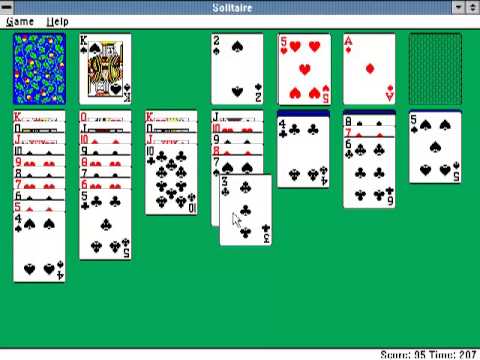
The fundamental objective is to successfully move all 52 cards from the tableau piles to the four foundation piles, sorted by suit and ascending rank (Ace through King). Players utilize a standard deck and interact with the tableau stacks, where cards must be placed in descending order while alternating colors (red on black, black on red).
The primary gameplay loop involves drawing cards from the stock pile—players can typically select modes that allow drawing either one card or three cards per pass through the stock—and strategically placing them onto the tableau or the foundations. A key element of the strategy involves uncovering face-down cards within the tableau piles to unlock further potential moves and clear space for organization.
What are the available play modes?
While the underlying ruleset is singular, the experience is differentiated by selectable variations that adjust the difficulty and pace of play. These variations primarily concern the stock draw rule (one card vs. three cards) and sometimes include options for shuffling the deck when the stock runs out.
Setting and Atmosphere
There is no narrative or complex setting associated with this implementation; the environment is purely functional, focused entirely on the visual representation of the card layout itself. The design prioritizes clarity and ease of interaction for the puzzle-solving task at hand.
Content Availability
This main game package is self-contained. It represents a complete implementation of the base card game, and there are no official downloadable content (DLCs) or expansions associated with this specific version.
Platform Availability and History
This iteration was initially launched on May 22, 1990, and is intrinsically linked to the PC platform running the Windows operating system. While the core concept has seen numerous updates and remakes across decades to align with modern operating systems, this version represents the foundational digital implementation of the patience game.
Game Details
Primary Name: Microsoft Solitaire
Alternative Names:
MS Solitaire (Acronym)
Solitaire (Alternative title)
Windows Solitaire (Alternative title)
Type: Main Game
Series: Microsoft Entertainment Pack
Developer: Microsoft
Publisher: Microsoft
Release Information
Release Date: May 22, 1990
Genres & Themes
Genres: Card & Board Game
Platforms
PC (Microsoft Windows)
Game Modes
Perspective: Bird view / Isometric
Player Modes: Single-player
Game Modes: Single player
 Soren
Soren