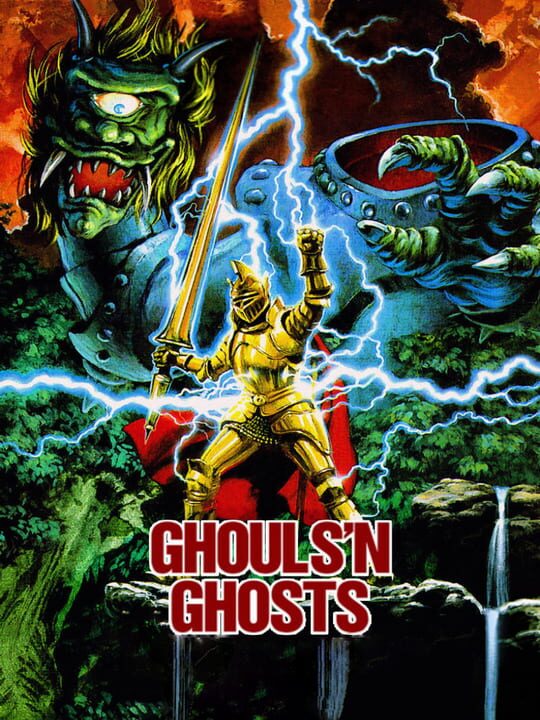
Ghouls 'n Ghosts
Overview:|
As a port of the 1988 arcade classic, Ghouls 'n Ghosts is a side-scrolling action platformer where you control the knight Arthur through dark, challenging realms. The core gameplay loop involves precise jumping and combat against hordes of supernatural enemies. A distinctive feature is the armor system: taking one hit strips Arthur down to his boxers, and a second hit results in death. Released initially in 1989, this title is known for its high difficulty and demands mastery of various found weapons for survival across its unforgiving stages.
This title, originally released in arcades in 1988 and ported to home systems starting in 1989, is a side-scrolling action platformer that functions as the direct sequel to the first entry in the series. As a Port, it brings the demanding arcade experience to home consoles, specifically noted for its availability on the Sega Mega Drive/Genesis and later the Wii. Players assume the role of the knight Arthur, whose objective is to traverse hostile, supernatural environments to rescue a princess. The setting is characterized by dark fantasy elements populated by various undead and demonic adversaries.
Core Gameplay and Mechanics
The gameplay loop is built around precise platforming and combat across numerous hazardous stages. You must guide Arthur through levels filled with environmental hazards, bottomless pits, and enemies that attack with predictable, yet relentless, patterns. A central mechanic involves Arthur's armor: he starts protected, but upon sustaining a single hit, the armor is destroyed, leaving him vulnerable in his boxers. A second blow results in the loss of a life.Weapon management is a critical component of survival. Arthur can acquire and switch between various armaments found during the adventure, such as lances, axes, and daggers. Each weapon possesses distinct properties regarding firing speed and trajectory, requiring players to adapt their attack strategy based on the current armament.
What is the primary challenge of this game?
The game is widely recognized for its exceptionally high difficulty level. Success hinges on mastering precise timing, recognizing enemy attack patterns, and often requires numerous attempts to clear specific sections. A distinct feature of this classic platformer design is the requirement, upon initially completing the game, for the player to replay the entire adventure under significantly harsher conditions to unlock the true narrative conclusion.
Port Information and Content
This version represents a direct adaptation of the original arcade game for home console hardware. Ports from this era focused on faithfully recreating the core challenge and visual presentation within the technical limitations of the target system, such as the Sega Mega Drive/Genesis.In terms of content, this specific release iteration is self-contained. It includes no downloadable content (DLC) and no standalone expansions. The experience delivered is the complete, intended adventure as it was designed for the console platform.
Platform Availability Context
This demanding action platformer first appeared on the Sega Mega Drive/Genesis in 1989. It has since been made available on other systems, including the Nintendo Wii, providing access to this classic title for different generations of players.
What kind of experience does this game offer?
It delivers a focused, skill-based 2D platforming experience set within a gothic, horror-tinged world. The primary value proposition for players lies in the mastery of its unforgiving mechanics and the satisfaction derived from overcoming its steep, inherent difficulty curve.
Game Details
Primary Name: Ghouls 'n Ghosts
Alternative Names:
Daimakaimura (Japanese title - romanization)
Type: Port
Part of: Ghouls 'n Ghosts
Series: Ghosts 'n Goblins
Developer: Capcom
Publisher: Capcom, Sega, Tec Toy
Release Information
Release Date: Aug 3, 1989
Genres & Themes
Genres: Platform
Themes: Action, Fantasy, Horror
Platforms
Sega Mega Drive/GenesisWii
Game Modes
Perspective: Side view
Player Modes: Single-player
Game Modes: Single player
Age Ratings
ESRB:E (Everyone)
Videos
No videos available for this game.
 Soren
Soren