
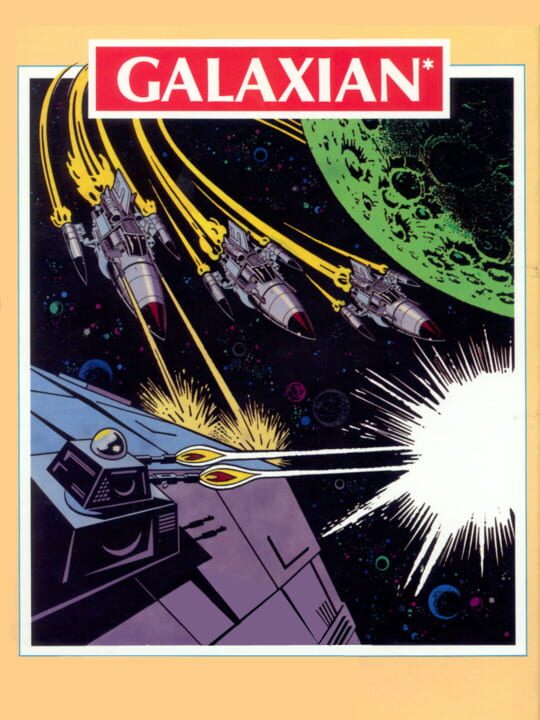
Galaxian
Overview:|
As a 1984 Port of a classic arcade shooter, Galaxian for DOS delivers a pure, skill-based experience where you pilot a lone starfighter against descending alien squadrons. The core gameplay involves rapid-fire shooting while maneuvering to dodge unpredictable enemy dive patterns. This version focuses entirely on the foundational, high-score pursuit mechanics of the original fixed shooter genre, offering a direct translation of that time-tested challenge to personal computers.
This title, released in 1984, represents a significant piece of arcade history brought to personal computers. As a port, it delivers the core, time-tested experience of its influential predecessor directly to the DOS platform. The atmosphere is defined by classic, high-stakes space combat, placing the player in command of a lone starfighter against overwhelming odds. The setting is straightforward: deep space, where survival depends entirely on quick reflexes and precise maneuvering against waves of alien adversaries.
Core Gameplay Mechanics and Experience
The fundamental appeal of this shooter lies in its immediate, addictive gameplay loop. Players control a spacecraft positioned at the bottom of the screen, tasked with eliminating descending formations of alien enemies before they can reach the bottom or successfully attack the player's vessel. The primary mechanic involves rapid-fire shooting, requiring players to weave between enemy formations while simultaneously targeting them.
A unique feature of the enemy behavior involves their distinct, often unpredictable dive patterns. These alien ships attack in organized, colorful squadrons, breaking formation to execute aggressive, swooping attacks against the player's ship. Successfully clearing a wave often results in a challenging bonus stage where enemies move more erratically.
What defines this port's value proposition?
As a port from the arcade era, the value proposition centers on experiencing a foundational entry in the fixed shooter genre on a home computer system. It focuses purely on skill-based progression, demanding mastery over movement and timing to achieve higher scores. The experience is characterized by escalating difficulty and the pursuit of high-score longevity.
Platform Availability and Release Context
This specific version was published for the DOS platform, making it accessible to users of personal computers during the mid-1980s. It arrived on December 31, 1984, translating the fast-paced action originally developed by Namco for the arcade into a home environment managed by Atari as the publisher.
Additional Content Status
Regarding supplementary material, this release stands as a self-contained experience. There are currently no recorded DLCs or expansions associated with this 1984 DOS version.
Is this game playable on modern systems?
While originally designed for DOS, its status as a classic port means that modern playability often relies on emulation or compatibility layers designed for older operating systems.
Game Details
Release Information
Release Date: Dec 31, 1984
Genres & Themes
Genres: Shooter
Themes: Science fiction
Platforms
DOS
Game Modes
Perspective: Bird view / Isometric
Player Modes: Single-player
Game Modes: Single player
Screenshots
No screenshots available for this game.
Videos
No videos available for this game.
 Soren
Soren