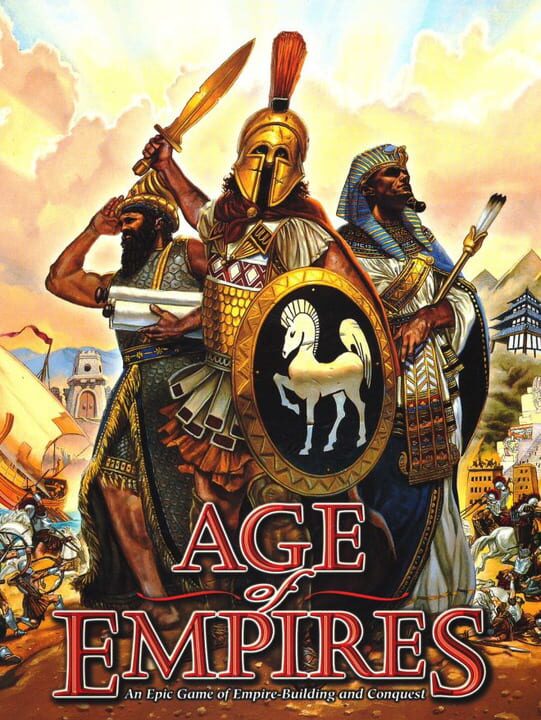
Age of Empires
Main Game
RELEASED
8.3
Oct 15, 1997
PC (Microsoft Windows)MacbyEnsemble Studios•Microsoft
Overview:|
As a foundational real-time strategy main game released in 1997, Age of Empires tasks you with leading one of twelve ancient civilizations from the Stone Age to the Iron Age. The core loop involves gathering finite resources to build structures, research technologies, and train unique units across four distinct eras. Success requires careful economic management and strategic advancement, as each civilization possesses exclusive technologies, demanding adaptation to secure victory.
This is a foundational real-time strategy title released in 1997 for PC (Microsoft Windows) and Mac. Set against the backdrop of ancient history, the game places players in the role of a civilization's leader, tasked with guiding their people from humble beginnings to the height of an Iron Age empire. Utilizing a 2D sprite-based engine, the core experience revolves around resource management, technological research, and military development to achieve victory over rival societies.
Core Gameplay Loop: From Gatherers to Empire
The primary objective involves developing a small group of hunter-gatherers into a powerful, expansive civilization. Success hinges on the careful gathering and allocation of essential resources. These resources are necessary to construct buildings, train new military units, and research critical technological upgrades. A key strategic element is the finite nature of the world's resources; once a tree is felled or a mineral deposit is depleted, those specific resources do not regenerate, demanding long-term planning and conservation.
The Four Ages of Advancement
A central mechanic defining progress is the advancement through four distinct historical eras: the Stone Age, the Tool Age, the Bronze Age, and finally, the Iron Age. Researching advancement at the central Town Center unlocks access to superior technologies, more powerful weaponry, and specialized military units appropriate for the current era. This structured progression dictates the pace and strategic options available to the player throughout a match.
Civilizational Diversity
The game features twelve distinct civilizations, each possessing unique attributes that influence gameplay. No single civilization has access to every technology available within the game; instead, each group possesses technologies unique to them, so that no civilization possesses all the technologies possible within the game. This asymmetry ensures that players must adapt their strategy based on the civilization they choose, as certain paths to victory may be more readily available to one group over another.
What defines the strategic depth of this historical RTS?
The strategic depth emerges from balancing immediate needs—such as gathering food, wood, and stone—with long-term goals, primarily the research required to transition into the next historical age. Players must manage their economy efficiently while simultaneously scouting opponents and preparing defenses or offensives appropriate for their current technological tier.
Additional Content and Current State
While the base game is self-contained, it has received one official expansion pack to augment the core experience. There are no official DLCs associated with this initial release. A remastered version of the game is also available, updating the visuals and compatibility for modern systems, reflecting ongoing support for this classic title.
Game Details
Primary Name: Age of Empires
Alternative Names:
AoE (Acronym)
AoE1 (Acronym)
Age of Empires 1 (Alternative spelling)
帝国时代 (Chinese title - simplified)
世紀帝國 (Chinese title - traditional)
Tribe (Working title)
Diguo Shidai (Chinese title - traditional)
Dawn of Man (Working title)
Type: Main Game
Series: Age of Empires
Developer: Ensemble Studios
Publisher: Microsoft, MacSoft Games
Engine: Genie Engine
Release Information
Release Date: Oct 15, 1997
Genres & Themes
Genres: Strategy
Themes: Warfare, Historical
Platforms
PC (Microsoft Windows)Mac
Game Modes
Perspective: Bird view / Isometric
Player Modes: Online Co-op, Multiplayer
Game Modes: Single player, Multiplayer
Age Ratings
ESRB:T (Teen)
PEGI:12+

 Soren
Soren