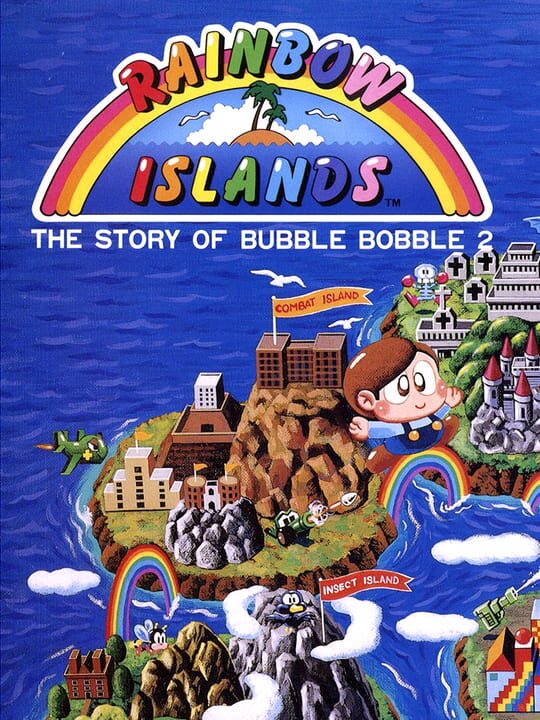
Rainbow Islands: The Story of Bubble Bobble 2
Main Game
RELEASED
7.7
31 déc. 1987
Turbografx-16/PC Engine CDPC (Microsoft Windows)+7byTaito•NEC Avenue
Aperçu:|
{"overview":"
Rainbow Islands: The Story of Bubble Bobble 2 est un jeu d'arcade de plateforme et de puzzle, suite directe du succès de 1987. Votre mission est de traverser les dix îles pour collecter des gemmes et des miroirs afin de vaincre le Boss de l'Ombre et de sauver les habitants transformés en dragons. Le gameplay repose sur la navigation et la capture d'ennemis dans des bulles avant de les faire éclater, avec l'introduction de la magie de l'arc-en-ciel comme mécanique clé de progression. Le jeu a été porté sur de nombreuses consoles et ordinateurs, et a bénéficié d'un remaster.
","tokens":{"input":2472,"output":150,"total":2622}}{"overview":"
\nCe titre, sous-titré \"The Story of Bubble Bobble 2\", est un jeu d'arcade classique de plateforme et de puzzle, initialement lancé en 1987. Il s'agit de la suite directe du succès de l'année précédente, poursuivant l'aventure dans un monde vibrant et coloré. Les joueurs se lancent dans une quête à travers les îles éponymes pour inverser une transformation magique affectant les habitants locaux. Le jeu a fait l'objet de nombreux portages sur divers ordinateurs personnels et consoles, incluant le Commodore 64, l'Amiga, l'Atari ST, et le TurboGrafx-16/PC Engine.\n
\n\nLe Scénario et l'Ambiance
\nL'intrigue se concentre sur deux protagonistes qui partent secourir les habitants des Îles Arc-en-ciel. Ces insulaires ont été transformés en Dragons Bulles par le maléfique Boss de l'Ombre. Pour ramener tout le monde à la normale, les héros doivent traverser les dix îles distinctes de l'Arc-en-ciel, collectant des gemmes et des miroirs majeurs dispersés dans les niveaux avant d'affronter l'antagoniste final.
\n\nMécaniques de Jeu Principales
\nEn tant que jeu de plateforme intégrant de solides éléments de puzzle, la boucle de gameplay implique de naviguer dans des niveaux remplis d'ennemis et d'obstacles. Une mécanique centrale réside dans l'utilisation d'une méthode unique pour piéger les adversaires. Plutôt que des attaques directes, les joueurs doivent enfermer les ennemis dans des bulles temporaires. Une fois l'ennemi contenu, le joueur doit faire éclater la bulle, souvent en sautant dessus ou en utilisant des interactions environnementales, pour éliminer la menace.
\n\nUne caractéristique clé qui distingue cette suite est l'introduction de la magie de l'arc-en-ciel. Réussir à terminer des niveaux et collecter des objets entraîne souvent l'apparition d'arcs-en-ciel, qui sont essentiels à la progression et au score. Maîtriser le timing et le placement de ces effets d'arc-en-ciel est crucial pour réussir.
\n\nQu'est-ce qui rend ce jeu unique dans le genre plateforme ?
\nLe jeu mélange un gameplay de plateforme rapide avec une manipulation stratégique des bulles, créant un défi distinct qui exige à la fois des réflexes rapides et un positionnement réfléchi. Le système de progression est directement lié à la collecte d'artefacts puissants — les grosses gemmes et les miroirs — nécessaires pour faire avancer l'histoire à travers les différents environnements insulaires.
\n\nDisponibilité du Contenu
\nL'expérience de jeu principale est proposée sans aucun contenu téléchargeable (DLC) ou extension. Bien qu'une remasterisation ait été publiée depuis ses débuts, le contenu de base reste cohérent avec la version arcade originale de 1987.
\n\nDisponibilité sur Plateformes
\nCe titre possède une empreinte de sortie historique étendue, apparaissant sur des plateformes telles que l'Arcade, le ZX Spectrum, l'Amstrad CPC, le Commodore C64/128/MAX, l'Amiga, l'Atari ST/STE, et le TurboGrafx-16/PC Engine, y compris une version sur CD-ROM pour ce dernier système. Il a également été rendu disponible sur PC (Microsoft Windows).
","tokens":{"input":2664,"output":816,"total":3480}}Game Details
Primary Name: Rainbow Islands: The Story of Bubble Bobble 2
Alternative Names:
Bubble Bobble 2 (Alternative title)
Rainbow Islands (Japanese title - translated)
Rainbow Islands: Story of Bubble Bobble II (Alternative spelling)
Type: Main Game
Series: Rainbow Islands
Developer: Taito
Publisher: NEC Avenue, MediaKite Distribution, Taito, Romstar
Release Information
Release Date: déc. 31, 1987
Genres & Themes
Genres: Platform, Puzzle, Arcade
Themes: Action, Fantasy
Platforms
Turbografx-16/PC Engine CDPC (Microsoft Windows)Commodore C64/128/MAXTurboGrafx-16/PC EngineZX SpectrumAmigaAmstrad CPCArcadeAtari ST/STE
Game Modes
Perspective: Side view
Player Modes: Single-player
Game Modes: Single player, Multiplayer

 Soren
Soren