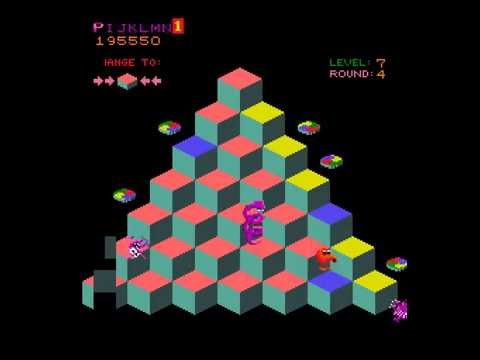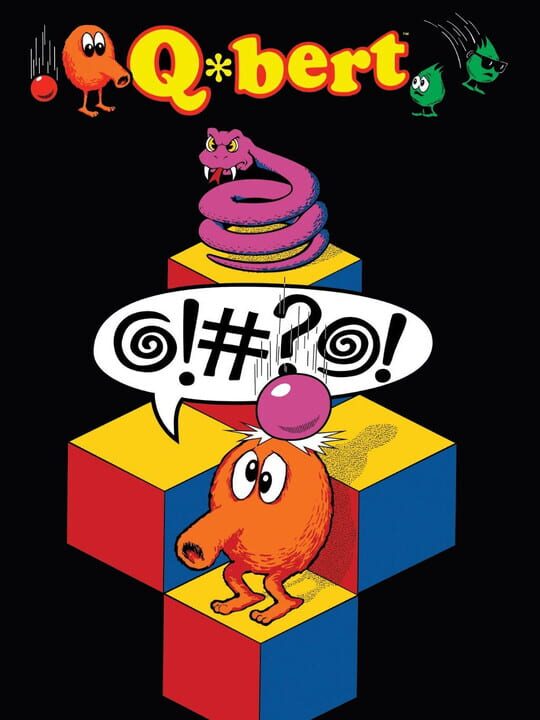
Ce jeu d'arcade classique de 1982, précurseur du jeu de plateforme isométrique, vous met dans la peau de Q*bert. Votre objectif principal est de sauter sur chaque cube d'une pyramide pour changer sa couleur, tout en évitant des ennemis qui vous pourchassent. Le gameplay repose sur la planification spatiale dans un environnement en pseudo-3D. Bien qu'il n'y ait pas d'histoire développée, le défi réside dans la maîtrise des mouvements et la survie. Disponible sur Arcade et PlayStation 3, il est reconnu pour son style visuel unique.
","tokens":{"input":2141,"output":136,"total":2277}}Le déplacement s'effectue par des sauts directionnels. Bien que l'objectif soit simple — changer toutes les couleurs — la difficulté augmente rapidement avec l'introduction de diverses entités antagonistes qui patrouillent la structure.
\n\nLe jeu est remarquable pour son utilisation de graphismes isométriques afin de créer l'illusion d'un espace tridimensionnel sur un plan bidimensionnel. Ce style visuel, rappelant des concepts comme l'escalier de Penrose, a défini son esthétique et l'a distingué des jeux de plateforme à défilement latéral contemporains. Il fonctionne fondamentalement comme un jeu de puzzle où la conscience spatiale et le timing sont cruciaux pour la survie.
\n\nPour empêcher le joueur de compléter facilement l'objectif, plusieurs types d'ennemis sont introduits. Ces créatures poursuivent activement le personnage à travers les faces des cubes. Éviter ou neutraliser ces menaces tout en maintenant la progression sur la tâche de changement de couleur constitue la tension centrale de l'expérience.
\n\nLe jeu présente une prémisse simple sans structure narrative profonde, typique de ses origines en arcade. L'accent reste entièrement mis sur la maîtrise des mécaniques de mouvement et la survie face aux schémas de plus en plus complexes des entités hostiles.
\n\nEn tant que titre d'arcade classique, ce jeu principal ne propose pas de contenu téléchargeable (DLC) ou d'extensions officielles publiées pour cette version. Cependant, la popularité durable du concept a engendré de multiples refontes au fil des années.
\n\nL'itération originale de ce jeu est sortie sur les machines d'arcade. Son accessibilité moderne inclut des portages disponibles sur des plateformes telles que la PlayStation 3.
","tokens":{"input":2333,"output":669,"total":3002}}
One of the most critically acclaimed and commercially successful arcade games of the 1980s is back in its Classic pixel perfect 2D form, and a re-imagined Reboot version with state of the art 3D game-play and graphics that remain faithful to the original concept.

Q*bert is a remake of the arcade game of the same name with three-dimensional (3D) graphics. It was developed by Artech Studios and released by Hasbro Interactive on the PlayStation and PC in 1999 and on the Dreamcast in 2000. Q*bert has 3 modes of play. Classic is like the original Q*bert, and the graphics can be changed from Retro to Modern. The Adventure mode takes Q*bert to 3D dimensions, and contains power ups and all new characters set in 4 worlds. Head to Head is a multiplayer mode.

Q*bert for Game Boy brings new challenges to the classic series.

NES port of Q*Bert.

Q*bert is a MSX game developed by Konami in 1986. Despite sharing the same name as the original, it has gameplay styled after Q*bert's Qubes. the title character being replaced by Wrappy (konami MSX research team mascot) that has draconic appearance with small eyes, a visible, expressive mouth, arms, purple skin, yellow spines, and a somewhat long tail.

Q*bert is an isometric platform game with puzzle elements where the player controls the titular protagonist from a third-person perspective. Q*bert starts each game at the top of a pyramid of cubes, and moves by jumping diagonally from cube to cube. Landing on a cube causes it to change color, and changing every cube to the target color allows the player to progress to the next stage.

Q*bert is an isometric platform game with puzzle elements where the player controls the titular protagonist from a third-person perspective. Q*bert starts each game at the top of a pyramid of cubes, and moves by jumping diagonally from cube to cube. Landing on a cube causes it to change color, and changing every cube to the target color allows the player to progress to the next stage.

Q*bert is an arcade game by Gottlieb. It was ported to the SG-1000 by Tsukuda Original, who marketed it for their Othello Multivision console. The objective of the game is to turn all the cubes on screen to a desired colour by moving Q*bert on top of them. Q*bert can only move in diagonals, and the player needs to be careful not to either send Q*bert off the edge or have him collide with enemies/obstacles. Occasionally cylindrical platforms appear on the edge of the screen, which when jumped on, will take Q*bert to the top. The SG-1000 port is a very bare-bones rendition of the game and is missing many elements seen in the arcade version. It is also much harder as the port sends out more enemies in the first few levels.

A handheld conversion of Q*Bert arcade game.

Q*bert is an isometric platform game with puzzle elements where the player controls the titular protagonist from a third-person perspective. Q*bert starts each game at the top of a pyramid of cubes, and moves by jumping diagonally from cube to cube. Landing on a cube causes it to change color, and changing every cube to the target color allows the player to progress to the next stage.

Q*bert is an isometric platform game with puzzle elements where the player controls the titular protagonist from a third-person perspective. Q*bert starts each game at the top of a pyramid of cubes, and moves by jumping diagonally from cube to cube. Landing on a cube causes it to change color, and changing every cube to the target color allows the player to progress to the next stage.

A handheld conversion of Q*Bert arcade game.

Q*bert is an isometric platform game with puzzle elements where the player controls the titular protagonist from a third-person perspective. Q*bert starts each game at the top of a pyramid of cubes, and moves by jumping diagonally from cube to cube. Landing on a cube causes it to change color, and changing every cube to the target color allows the player to progress to the next stage.

Q*bert is a popular arcade game. The goal is to change all of the tiles on a pyramid to the target color. To do this you guide Q*bert around the pyramid, and every tile he hops on will change color. On early levels, a single hop will change the tile to the desired color, but on later levels, you may need to hop on a tile multiple times or even avoid hopping on a tile multiple times! Trying to stop Q*bert are many different creatures wandering around the board, including Coily the snake, Slick and Sam, and falling balls. On the edge of the board are floating discs; if Q*bert jumps on one of these discs when the snake is in pursuit, the snake will fall off the board while Q*bert is safely transported to the top.

Q*bert is a popular arcade game. The goal is to change all of the tiles on a pyramid to the target color. To do this you guide Q*bert around the pyramid, and every tile he hops on will change color. On early levels, a single hop will change the tile to the desired color, but on later levels you may need to hop on a tile multiple times or even avoid hopping on a tile multiple times! Trying to stop Q*bert are many different creatures which wander around the board, including Coily the snake, Slick and Sam, and falling balls. On the edge of the board are floating discs; if Q*bert jumps on one of these discs when the snake is in pursuit, the snake will fall off the board while Q*bert is safely transported to the top.

A handheld conversion of Gottlieb's Q*Bert arcade game.

All the action and excitement of the popular arcade game are here! Hop Q*bert up and down a pyramid of cubes, changing colors on each of the cube tops. When they're all the same color, Q*bert moves to a new - and more difficult - pyramid. But strange characters want to stop Q*bert from his fanciful mission. You'll have to do some fast hopping in this quick and "quasy" game! 1 or 2 players.

Q*bert is an isometric platform game with puzzle elements where the player controls the titular protagonist from a third-person perspective. Q*bert starts each game at the top of a pyramid of cubes, and moves by jumping diagonally from cube to cube. Landing on a cube causes it to change color, and changing every cube to the target color allows the player to progress to the next stage.