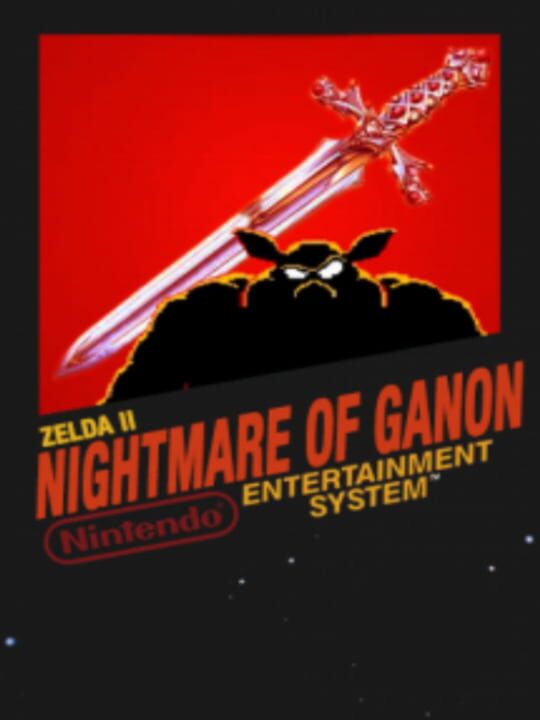
Zelda II: The Nightmare of Ganon
Mod
RELEASED
Feb 5, 2018
Nintendo Entertainment SystembyHollowShadow•Unknown
Part of: Zelda II: The Adventure of Link
Overview:|
As a 2018 Mod for the NES, Zelda II: The Nightmare of Ganon completely redesigns the original adventure, offering a fresh, challenging experience focused on intricate level design rather than simple stat increases. You explore a larger overworld with new caves and deeper palaces, facing respawning enemies. Distinctive features include custom gameplay changes like restarting at the palace upon game over, making this a demanding platform adventure for those seeking a fundamentally new take on the classic formula.
This title, released in 2018, is a significant modification, or "Mod," built upon the foundation of the classic Nintendo Entertainment System (NES) adventure, Zelda II: The Adventure of Link. As a platform-genre modification, it offers players a completely overhauled experience that retains the core structure of the original while introducing substantial new content and design philosophies. It is designed to present a fresh, demanding challenge to those familiar with the source material.
Core Experience and Game Type Context
As a Mod, this game represents a complete reimagining of the original adventure, offering a new narrative framework, redesigned world map, and entirely new layouts for dungeons, towns, and caves. Unlike simple difficulty tweaks, this modification focuses on comprehensive design changes, ensuring that the progression, item acquisition order, and environmental puzzles feel distinct from the game it is based upon. The core value proposition lies in delivering a "totally new" adventure within the familiar 8-bit aesthetic and mechanics of the NES era.
What makes this game unique?
The difficulty scaling in this version is achieved primarily through intricate level design rather than simply increasing enemy health pools. While enemies may not take significantly more hits, the arrangement of encounters and the complexity of the environments present a substantial hurdle. Key design shifts include:
- A significantly expanded overworld, featuring more bridges and numerous additional caves.
- Deeper and more extensive palace structures requiring longer exploration sessions.
- The introduction of respawning enemies, adding persistent pressure to previously cleared areas.
- A custom gameplay feature allowing players to restart directly at the palace upon experiencing a game over, offering a specific concession for the increased challenge.
What is the gameplay loop like in this version?
The gameplay loop adheres to the side-scrolling action-RPG structure of its predecessor, requiring players to navigate the overworld, engage in random encounters, explore caves, and conquer multi-level palaces. However, the order of item acquisition has been altered, and the world map itself is larger, demanding more exploration. The inclusion of respawning enemies means that backtracking carries a higher risk than in the original title.
Setting and Atmosphere
The title suggests a narrative focus centered around the antagonist, Ganon. The atmosphere is rooted in the challenging, side-scrolling action-RPG format characteristic of its parent game, but the complete redesign of locations and the integration of random encounters contribute to a feeling of constant unpredictability and heightened tension across the revised map.
How does the challenge compare to the original?
This version is explicitly categorized as a "hardtype," meaning it is intentionally more difficult than the original Zelda II. The difficulty is engineered into the structure of the world—the placement of enemies, the complexity of the dungeons, and the necessity of navigating a larger world with new item dependencies—rather than relying on simple stat inflation.
Platform Availability
This modification is available exclusively on the Nintendo Entertainment System (NES) platform, requiring the original game data to be patched. It is important to note that this release contains no official downloadable content (DLC), expansions, remakes, or remasters beyond the initial 2018 release.
Game Details
Primary Name: Zelda II: The Nightmare of Ganon
Type: Mod
Part of: Zelda II: The Adventure of Link
Developer: HollowShadow
Publisher: Unknown
Release Information
Release Date: Feb 5, 2018
Genres & Themes
Genres: Platform
Platforms
Nintendo Entertainment System
Game Modes
Perspective: Side view
Player Modes: Single-player
Videos
No videos available for this game.
 Soren
Soren