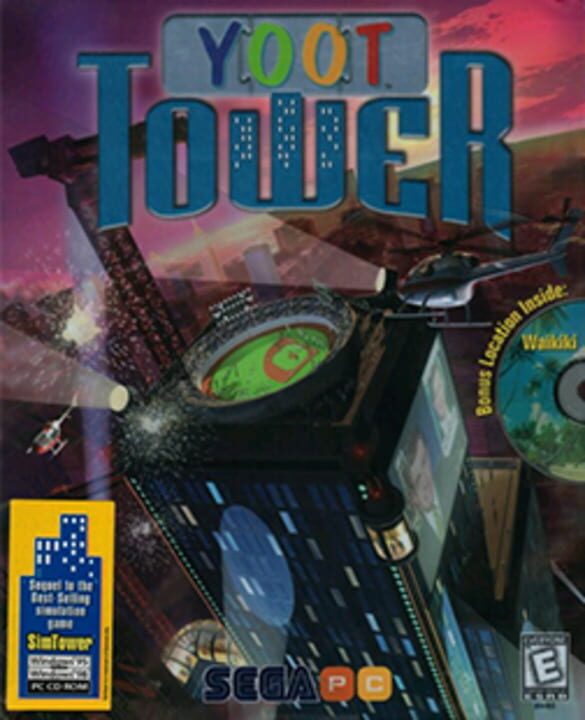
Yoot Tower
Main Game
RELEASED
Dec 31, 1998
PC (Microsoft Windows)MacbyOpenBook Co.
Overview:|
As a 1998 strategy simulator, you build and manage a profitable, unique skyscraper by strategically placing residential, office, and retail facilities across multiple floors. The core loop involves balancing occupant needs—like access to amenities and efficient elevators—with maximizing revenue. Success requires meticulous planning to ensure the vertical ecosystem thrives, offering a detailed management challenge focused on structural optimization.
This title, released in 1998 for PC (Microsoft Windows) and Mac, is a Simulator and Strategy game focused entirely on vertical urban development. Players assume the role of a tower administrator tasked with constructing and managing a multi-story skyscraper complex. The core objective is to build a profitable and functional structure by carefully balancing the needs of various occupants—residential, commercial, and industrial—while ensuring the tower operates efficiently through strategic infrastructure placement.
Core Gameplay Loop: Vertical Construction and Management
The primary gameplay revolves around strategic construction and resource management within a confined vertical space. You must decide where to place different types of facilities—ranging from apartments and offices to retail spaces and specialized amenities—across numerous floors. Each placement choice directly impacts the tower's overall appeal, tenant satisfaction, and profitability metrics.Success hinges on maintaining a delicate equilibrium. Residential tenants require access to services and comfortable living conditions, while businesses demand high foot traffic and efficient infrastructure. Poor planning, such as placing noisy industrial zones directly beneath luxury apartments, can lead to dissatisfied tenants, decreased income, and stagnation of growth.
Infrastructure and Tenant Demands
A key mechanical element involves managing the tower's internal systems, including utilities, maintenance, and especially transportation. Elevators must be strategically placed, upgraded, and managed to handle the flow of people between floors efficiently, as bottlenecks can severely impact tenant happiness. Furthermore, the introduction of various amenities—such as restaurants, theaters, or medical facilities—is crucial for attracting and retaining high-value tenants who contribute more significantly to the tower's revenue stream.The game presents a continuous challenge of optimizing floor space utilization. Players must continuously adapt their building layout as demand shifts, often requiring the demolition and reconstruction of sections to meet evolving occupant requirements and maximize revenue potential across the entire structure.
What makes this management experience unique?
While sharing a foundational premise with other city-building simulations, this game introduces specific layers of complexity related to tenant interaction and long-term structural planning within a single building envelope. The atmosphere is one of meticulous, detailed management, where every floor placement decision carries significant weight for the tower's long-term viability.Progression and Expansion
The game encourages long-term vision. As the tower grows in stature and reputation, new technologies and building options become available, allowing for increasingly complex and specialized tower designs. The strategic goal is not just to build tall, but to build smart, creating a self-sustaining vertical ecosystem that caters to diverse needs simultaneously.Are there any recent updates or expansions available?
As a main title originally released in 1998, this game currently features no official downloadable content (DLC) or expansion packs. The core experience provided upon its initial release represents the complete content offering.
Game Details
Primary Name: Yoot Tower
Alternative Names:
The Tower II (Other)
The Tower 2 (Other)
Type: Main Game
Series: SimTower
Developer: OpenBook Co.
Publisher: OpenBook Co., Sega
Release Information
Release Date: Dec 31, 1998
Genres & Themes
Genres: Simulator, Strategy
Themes: Business
Platforms
PC (Microsoft Windows)Mac
Game Modes
Perspective: Side view
Player Modes: Single-player
Game Modes: Single player
Age Ratings
ESRB:E (Everyone)
Screenshots
No screenshots available for this game.
Videos
No videos available for this game.
 Soren
Soren