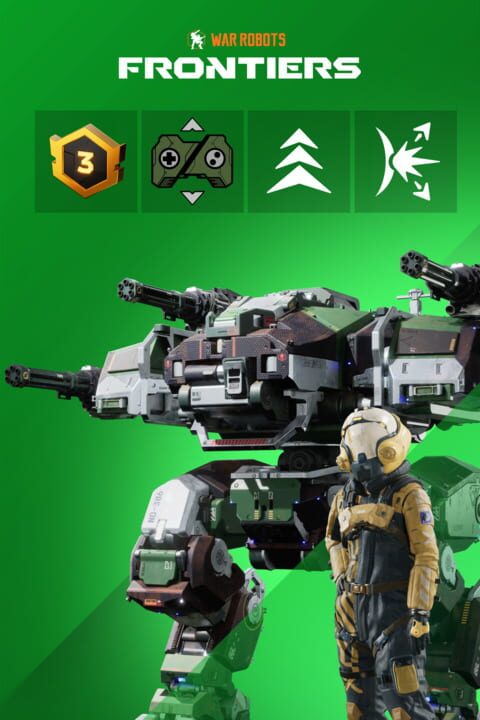
War Robots: Frontiers - Lancelot Rising
Overview:|
War Robots: Frontiers - Lancelot Rising, released in early 2025, centers on tactical mechanized combat, likely featuring 2 or 3-player modes. Success hinges on strategically deploying battle supplies to enhance combat effectiveness, requiring careful resource management and tactical decision-making within robotic warfare scenarios.
This title, released in early 2025, centers on intense, mechanized combat experiences, primarily featuring 2-player and 3-player team-based engagements. Players pilot large robotic units, engaging in strategic battles across various arenas. Success hinges on the effective deployment and utilization of specialized battle supplies, which serve to enhance the combat effectiveness of the deployed machines.
Core Gameplay Loop and Mechanics
The fundamental gameplay loop involves selecting a mech loadout, entering a mission, and engaging in tactical combat against opposing forces. Resource management is a critical component; players must decide when and how to deploy limited battle supplies to gain an advantage, whether through defensive fortifications, offensive boosts, or tactical repositioning aids.
The combat emphasizes positioning and timing. Players are required to make continuous tactical decisions regarding movement, weapon engagement ranges, and the activation of specialized abilities tied to their chosen robotic chassis and supplementary supplies. The strategic deployment of these supplies is often the differentiator between victory and defeat.
Setting and Narrative Context
The setting suggests an expansion or evolution within the world of robotic warfare. The "Lancelot Rising" aspect hints at the introduction or focus on a specific advanced faction or technological breakthrough within this mechanized universe. The overarching narrative appears to push the boundaries of current robotic combat capabilities, focusing on advanced weaponry and tactical enhancements available to the pilots.
What Defines the Combat Experience?
The unique selling point of this iteration lies in the integration of battle supplies directly into the moment-to-moment combat decisions. Unlike pure mech simulators, this system requires players to manage an external inventory or deployment system alongside direct piloting controls. This adds a layer of strategic depth, forcing players to look beyond just their mech's inherent statistics.
How Does Resource Management Impact Battle?
Effective resource management dictates the flow of battle. Players must anticipate enemy movements and potential threats to ensure their limited supply pool is used optimally. Deploying a critical supply at the wrong moment can leave a player vulnerable during a crucial engagement, underscoring the importance of foresight and tactical planning in these smaller team formats (2v2 or 3v3).
Key Features Overview
The game focuses on tight, squad-based engagements where coordination is paramount. The available game modes support small-scale team operations, demanding high levels of synergy between the few players on a team to overcome opponents.
Game Details
Primary Name: War Robots: Frontiers - Lancelot Rising
Type: Pack / Addon
Part of: War Robots: Frontiers
Developer: Unknown
Publisher: Unknown
Release Information
Release Date: Feb 25, 2025
Platforms
Xbox Series X|SXbox One
Game Modes
Perspective: Unknown
Player Modes: Single-player
Game Modes: Multiplayer, Co-operative
Age Ratings
ESRB:T (Teen)
PEGI:12+
USK:12+
GRAC:12+
CLASS_IND:10+
ACB:M (Mature)
Videos
No videos available for this game.
 Soren
Soren