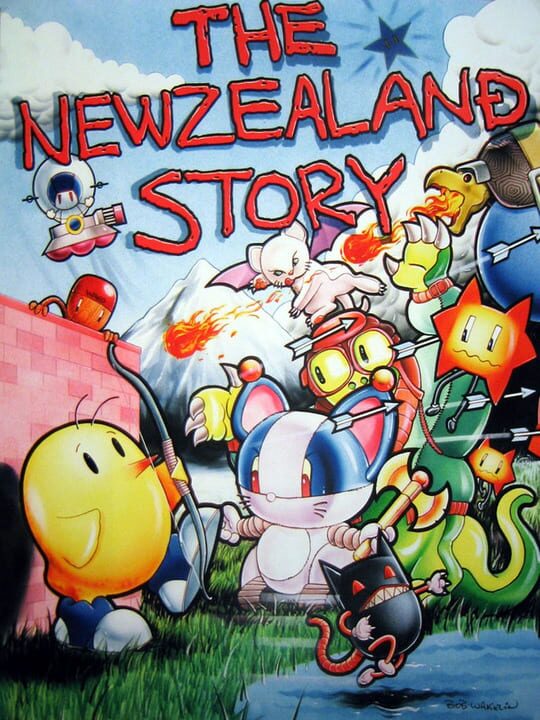
The NewZealand Story
Overview:|
This 1989 Port brings the classic 2D platform experience of *The NewZealand Story* to the Commodore C64/128/MAX systems. As a platformer, you navigate stages using precise jumping and movement to overcome obstacles and enemies, often utilizing a specific tool for interaction. This version reflects the technical translation of arcade action onto home computer hardware from that era, offering a historical look at platforming challenges tailored for the C64 architecture.
This title is a Port of a classic platform game, originally released in 1989. As a port, it translates the core experience of the original arcade or console release specifically for the Commodore C64/128/MAX systems. Players engage in classic 2D side-scrolling action, navigating various environments that demand precise jumping and movement to progress through distinct stages. The atmosphere is characterized by vibrant, albeit technically limited, graphics typical of late 1980s home computer gaming.
Core Gameplay Mechanics
The central challenge revolves around traversing levels filled with obstacles and enemies. Players control the protagonist, utilizing fundamental platforming skills to reach the end goal of each stage. A key element involves the use of a specific item—often a weapon or tool—that allows the player to interact with the environment or dispatch adversaries. Success relies heavily on timing and pattern recognition as you explore the game's world.
The game structure is linear, progressing through a series of increasingly complex maps. While the core mechanics are straightforward—run, jump, and attack—mastering the nuances of movement is essential for survival.
What is the value proposition of this specific port?
This version offers the experience of the original title adapted for the Commodore C64/128/MAX hardware. Ports from this era often present unique challenges and opportunities for players, as developers had to translate arcade-style action onto less powerful home systems. This adaptation provides a historical snapshot of how popular titles were translated for a specific computing platform during that time. The experience is defined by its adherence to the original design constraints of the source material, tailored for this specific 8-bit environment.
Game Content and Availability
The game is presented as a standalone experience. There are currently no reported DLCs or expansions available for this specific release. Furthermore, there are no official remakes or remasters associated with this 1989 version.
Platform Specifics
This iteration of the game was developed specifically for the Commodore C64/128/MAX family of computers, meaning the controls, visual presentation, and sound design are tailored to the capabilities of that hardware generation. It is published by Ocean and developed by Taito.
Game Details
Primary Name: The NewZealand Story
Type: Port
Part of: The NewZealand Story
Developer: Taito
Publisher: Ocean
Release Information
Release Date: Dec 31, 1989
Genres & Themes
Genres: Platform
Themes: Fantasy
Platforms
Commodore C64/128/MAX
Game Modes
Perspective: Side view
Player Modes: Single-player
Game Modes: Single player
Screenshots
No screenshots available for this game.
Videos
No videos available for this game.
 Soren
Soren