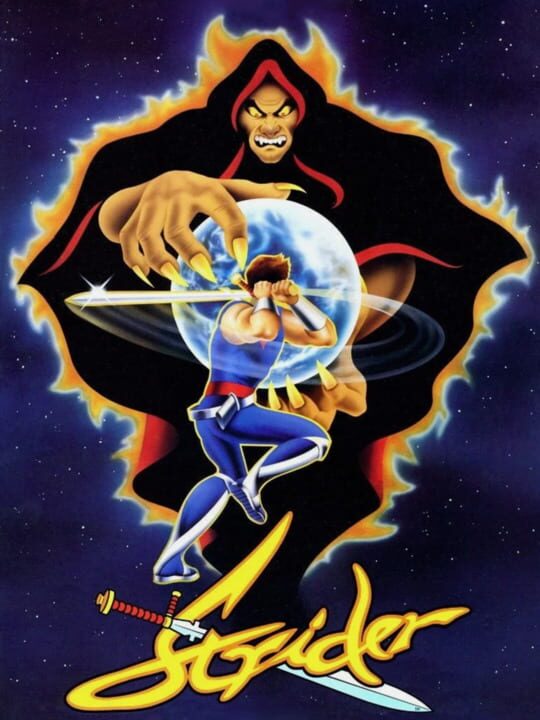
Strider
Main Game
RELEASED
6.8
Mar 1, 1989
DOSWii U+11byCapcom•U.S. Gold
Overview:|
Strider is a classic action-platformer, originally released in 1989, where you control Hiryu, an elite agent tasked with assassinating a dystopian dictator. Gameplay centers on precise 8-way movement, utilizing the plasma sword "Cypher" and acrobatic moves like cartwheels and slides. Key features include wall-climbing mechanics, collectible power-ups that enhance combat or health, and the ability to summon robotic companions. The mission spans five distinct stages, demanding efficient use of limited health and timers to progress.
This is a classic action-platformer set in a dystopian future in the year 2048, where a tyrannical dictator known as the "Grandmaster" holds dominion over the world. Players step into the role of Hiryu, the youngest operative ever to achieve the elite Super A Rank within the secretive organization of high-tech ninja-like agents known as the Striders. Hiryu is assigned the solitary, high-stakes mission of infiltrating the Grandmaster's stronghold and carrying out an assassination. Originally released in 1989, this title has seen numerous ports across platforms including Arcade, DOS, Sega Genesis, PlayStation, and Wii U, maintaining its core identity across decades of hardware.
Core Gameplay Mechanics and Movement
The gameplay centers on precise control over Hiryu, utilizing an eight-way joystick and two action buttons for combat and traversal. Hiryu’s primary weapon is the Cypher, a tonfa-like plasma sword. Mastering the controls allows players to execute a variety of acrobatic maneuvers essential for survival. These include a standard vertical jump, a cartwheel jump executed by moving left or right while jumping, and a slide maneuver used to pass under obstacles or enemies, initiated by crouching and then pressing the jump button.
Traversal and Combat Enhancements
A key element of movement involves Hiryu’s ability to latch onto specific platforms and traverse walls and ceilings using a metallic hook. Furthermore, running down a slope can build momentum, enabling a longer cartwheel jump than usual. Combat is supplemented by acquiring power-ups from item boxes carried by certain enemies. These items can extend the Cypher's attack range for a set number of slashes, provide health restoration (represented by specific kanji characters), grant an extra life, or offer a temporary state of invulnerability combined with enhanced attack power via shadow images.
Players can also summon robotic companions, known collectively as "options"—which consist of up to two mushroom-like droids, a saber-toothed tiger, and a hawk—to assist in fighting enemies.
What is the structure of the mission?
The mission is divided into five distinct stages, each presenting unique environmental challenges. The journey begins in the Kazakh Soviet Socialist Republic (referred to as "St. Petersburg" in the arcade attract sequence), progresses through the Siberian Wilderness, moves to the Aerial Battleship Balrog, continues through the Amazonian Jungle, and culminates at the Grandmaster's lair on the Third Moon. Each stage is segmented into smaller sections, each governed by an individual time limit and featuring designated checkpoint locations.
How is survival managed in this game?
Hiryu begins with a three-point health gauge, which can be upgraded to five points through specific health extensions found within stages. Failure results from the health gauge depleting entirely, moving Hiryu off the screen (such as falling into a bottomless pit), or the stage timer reaching zero. Losing all lives results in a Game Over, though the player is often given the opportunity to continue the attempt.
Current State and Audience Appeal
As a foundational title in the action-platformer genre, this game emphasizes tight controls and challenging level design. Its core appeal lies in mastering the complex movement set and optimizing combat efficiency against a variety of robotic and biological foes. Given its age and numerous ports across platforms like Arcade, Genesis, and modern systems like the Wii U, the game is primarily enjoyed by players seeking a demanding, classic arcade experience focused on skill execution rather than narrative depth or ongoing content updates, as this main game release currently has no officially documented Downloadable Content or expansions available.
Game Details
Primary Name: Strider
Alternative Names:
Strider Hiryuu (Japanese title - romanization)
STRIDER (Stylized title)
Type: Main Game
Series: Strider
Developer: Capcom, Capcom
Publisher: U.S. Gold, Capcom, Sega Enterprises, Ltd., Tec Toy
Release Information
Release Date: Mar 1, 1989
Genres & Themes
Genres: Platform, Arcade
Themes: Action, Science fiction
Platforms
DOSWii UCommodore C64/128/MAXSharp X68000ZX SpectrumSega Master System/Mark IIIAmigaAmstrad CPCArcadeSega Mega Drive/GenesisPlayStationWiiAtari ST/STE
Game Modes
Perspective: Side view
Player Modes: Single-player
Game Modes: Single player, Multiplayer
Age Ratings
ESRB:E10+ (Everyone 10+)

 Soren
Soren