
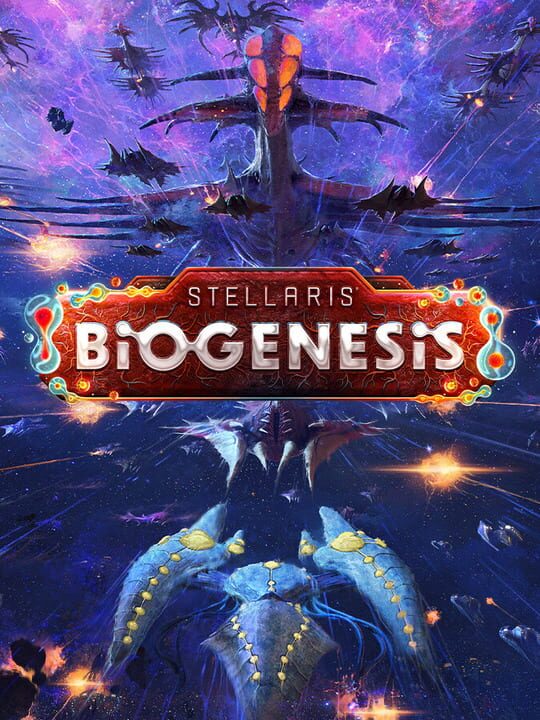
Stellaris: BioGenesis
DLC
RELEASED
May 5, 2025
LinuxPC (Microsoft Windows)+1byParadox Development Studio•Paradox Interactive
Part of: Stellaris
Overview:|
Stellaris: BioGenesis, a strategy simulator released in 2025, tasks you with guiding an interstellar civilization through empire building and resource management. Its core loop centers on deep genetic manipulation, allowing players to engineer species and create living starships. This focus on biological evolution and bioengineering tools distinguishes its grand strategy experience.
This is a strategy simulator, first released in May 2025, playable on PC, Mac, and Linux platforms. It places the player in command of an expanding interstellar civilization, requiring deep strategic management across a vast galaxy.
Core Gameplay Loop and Mechanics
The central experience revolves around empire building, resource allocation, and long-term strategic planning on a galactic scale. Players must manage internal stability while engaging with external political, scientific, and military challenges presented by other empires.
A defining mechanic of this title is advanced genetic manipulation. Players gain access to bioengineering tools that allow for the direct alteration of species traits. This can involve enhancing existing populations for specific roles, adapting them to harsh environments, or even engineering entirely new forms of life, such as specialized living starships.
Strategic Depth and Empire Management
Success requires balancing technological advancement with biological evolution. You will navigate diplomacy, research new societal structures, and manage planetary development. The game supports both single-player campaigns and multiplayer scenarios, allowing for competitive or cooperative empire management.
What makes this title's approach to strategy unique?
The primary differentiator lies in the emphasis on biological tools over purely mechanical or technological solutions. Instead of relying solely on traditional construction and research trees, players can leverage biological pathways to solve complex strategic problems. This includes exploiting environmental niches or creating specialized biological assets for military or economic advantage.
Evolutionary Paths and Adaptation
Players face choices regarding how deeply they wish to integrate genetic modification into their civilization. These choices impact long-term stability, potential conflicts with empires holding different ethical stances on life manipulation, and the overall trajectory of galactic influence.
Resource Management in a Biological Context
While standard resources are present, the management of biological assets—such as specialized gene pools or unique organic materials—becomes a critical layer of the economy. Efficiently harvesting and utilizing these biological resources directly influences the speed and scope of your civilization's evolution.
Game Details
Primary Name: Stellaris: BioGenesis
Type: DLC
Part of: Stellaris
Developer: Paradox Development Studio
Publisher: Paradox Interactive
Engine: Clausewitz Engine
Release Information
Release Date: May 5, 2025
Genres & Themes
Genres: Simulator, Strategy
Themes: 4X (explore, expand, exploit, and exterminate), Science fiction
Platforms
LinuxPC (Microsoft Windows)Mac
Game Modes
Perspective: Unknown
Player Modes: Single-player
Game Modes: Single player, Multiplayer
Age Ratings
PEGI:7+

 Soren
Soren