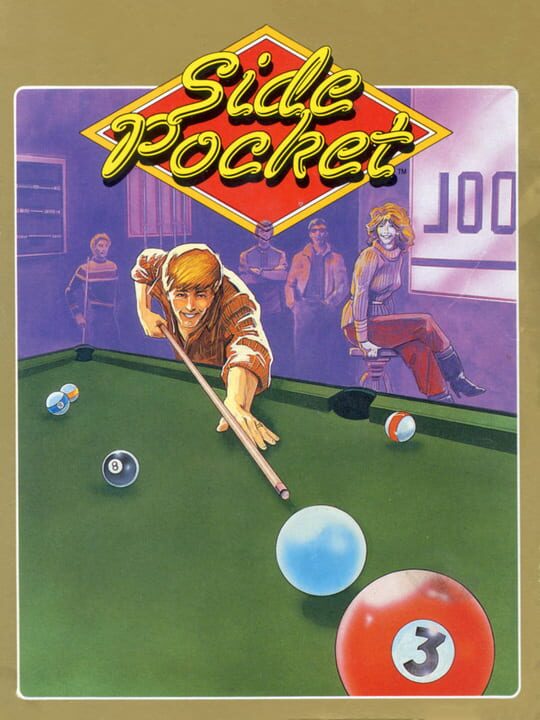
Side Pocket
Main Game
RELEASED
7.4
Jun 1, 1986
ArcadebyData East
Overview:|
Side Pocket is a classic arcade sports main game, first released in 1986, focusing entirely on the precision and strategy of pocket billiards. In this game, you aim and shoot the cue ball to sink numbered balls according to established pool rules, demanding accurate aiming and power control to master the table layout. Its appeal lies in delivering a pure, physics-based simulation of pool within a fast-paced arcade structure, and the core experience has seen at least one official remake since its debut.
This is a classic arcade sports title that transports players directly to the felt-covered tables of pocket billiards. Originally launched in arcades in 1986, this game captures the strategic depth and precision required for a satisfying game of pool, distilled into a fast-paced, accessible digital format. It serves as a foundational entry in the digital billiards genre, focusing purely on the mechanics of sinking balls.
Core Gameplay and Mechanics
The central experience revolves around simulating the physics and angles of traditional pocket billiards. Players take control of the cue stick, aiming shots to pocket numbered balls according to standard pool rulesets prevalent in the arcade environment of the mid-1980s. Success hinges on accurate aiming, power control, and understanding spin or "English" to control the cue ball's subsequent position on the table.
The game structure typically involves progressing through various challenges or stages, often centered around achieving specific scoring goals or clearing the table under certain conditions. While the premise is straightforward—sink the balls—the challenge escalates through increasingly difficult layouts or time constraints.
Atmosphere and Setting
The atmosphere is distinctly rooted in the early arcade era. The setting is purely the pool table itself, presented with the graphical limitations and stylistic choices characteristic of 1986 hardware. The focus is less on narrative and more on the immediate, competitive thrill of the sport.
What makes this game unique in the arcade sports genre?
Its uniqueness lies in its dedicated focus on the physics simulation of billiards within a competitive arcade framework. Unlike many contemporary sports titles that might blend genres, this game commits entirely to the precision required for pocket billiards, offering a pure test of aiming and cue ball control that was relatively novel in the arcade space at the time of its release.
Content Availability
As a main game released in 1986, the original arcade version is self-contained. There are currently no officially documented DLCs or expansions available for this specific title.
Platform History
While initially an arcade exclusive, this title saw subsequent ports to several home console platforms, broadening its reach beyond the coin-operated environment.
Has this game received modern updates?
While the original 1986 version remains the definitive classic, the intellectual property has seen continued life, including at least one recognized remake, suggesting ongoing interest in its core gameplay loop.
Game Details
Primary Name: Side Pocket
Alternative Names:
花式撞球 (Chinese title - simplified)
Type: Main Game
Series: Side Pocket
Developer: Data East
Publisher: Data East
Engine: DECO Cassette System
Release Information
Release Date: Jun 1, 1986
Genres & Themes
Genres: Sport, Arcade
Themes: Non-fiction
Platforms
Arcade
Game Modes
Perspective: Bird view / Isometric
Player Modes: Single-player
Game Modes: Single player, Multiplayer
Age Ratings
ESRB:E (Everyone)
Videos
No videos available for this game.

 Soren
Soren