
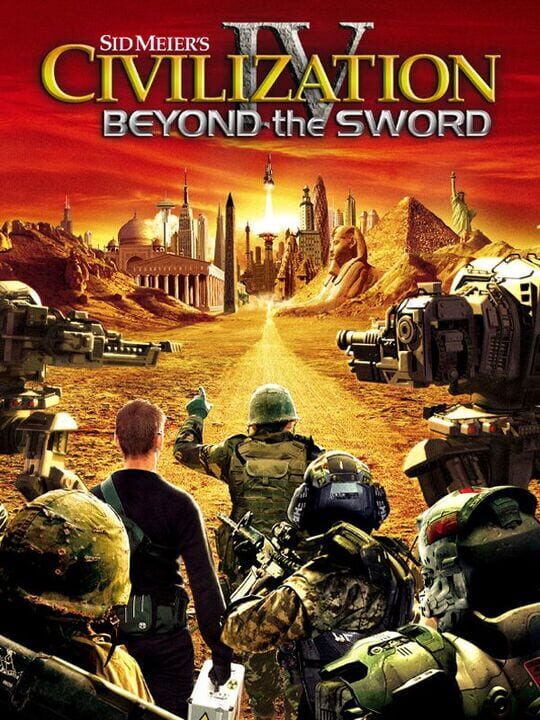
Sid Meier's Civilization IV: Beyond the Sword
Expansion
RELEASED
8.5
Jul 18, 2007
PC (Microsoft Windows)MacbyFiraxis Games•2K Games
Part of: Sid Meier's Civilization IV
Overview:|
As the second expansion for Civilization IV (2007), Beyond the Sword deepens the turn-based strategy experience, focusing heavily on post-gunpowder eras. It requires the base game and introduces ten new civilizations, sixteen leaders, and five wonders. Key mechanics include the addition of Corporations, earlier access to Espionage, new random Events, and enhanced late-game victory conditions. It also features eleven new community-designed scenarios and significantly upgraded AI behavior.
This is the second major expansion pack for the critically acclaimed Sid Meier's Civilization IV, released in 2007 for PC (Microsoft Windows) and Mac platforms. As a strategy simulator, this content significantly deepens the late-game experience, focusing heavily on the eras following the invention of gunpowder. It is not a standalone title and requires the base game to play, integrating its new features directly into the core turn-based strategy experience. The expansion adds substantial new mechanics and content, aiming to provide greater replayability and complexity, particularly as civilizations approach the modern age and beyond.
What New Content Does This Expansion Add?
This expansion introduces a wealth of new material designed to extend the epic scope of the game. Players gain access to ten entirely new civilizations, such as the Babylonians and the Netherlands, each bringing unique units and buildings to the strategic landscape. Furthermore, sixteen new leaders are added, offering alternate leadership options for existing civilizations alongside the leaders for the new ones, including figures like Abraham Lincoln and Hammurabi. The expansion also features five new World Wonders, including the Statue of Zeus and Cristo Redentor, which offer unique bonuses upon completion. The overall unit and building roster is expanded, providing more tactical options throughout the game's progression.Core Gameplay Enhancements and New Mechanics
How Does This Expansion Change Late-Game Strategy?
A major focus of this release is the expansion of the late game. The race for the Alpha Centauri space victory now requires more intricate planning and tactical decision making. Diplomatic options are also accelerated, as the United Nations equivalent, the Apostolic Palace, becomes available earlier, allowing for potential diplomatic victories sooner than in the base game. Two significant new systems are introduced to influence global politics and economics:- Corporations: Similar in function to the existing religion system, players can found and spread corporations across the globe. These entities provide specific economic or strategic benefits in exchange for resource upkeep.
- Espionage: The ability to engage in espionage is now accessible much earlier in the game. This mechanic allows players to gather intelligence on rivals, incite citizen unrest within enemy cities, and defend their own sensitive government secrets.
New Ways to Play and Challenge the AI
The expansion incorporates eleven new, challenging scenarios designed by the development team and members of the dedicated community. These scenarios offer focused objectives outside of the standard world conquest path. For players seeking a quicker experience or a different starting point, the Advanced Starts feature allows players to purchase components of a custom-tailored empire and begin play in the later stages of history. This lets players jump directly into the content added by the expansion. Finally, the artificial intelligence has received substantial upgrades. The Advanced AI is designed to rely less on artificial handicaps and more on intelligent strategic play across economic and military fronts, providing a more consistent challenge throughout the course of the game.What Platforms is This Content Available On?
This content was released for PC (Microsoft Windows) and Mac platforms. As an expansion, it requires the base game, Sid Meier's Civilization IV, to be played. The content is integrated directly into the core turn-based strategy experience.Game Details
Primary Name: Sid Meier's Civilization IV: Beyond the Sword
Alternative Names:
Sid Meier's Civilization 4: Beyond the Sword (Other)
Sid Meier's Civilization 4: Beyond the Sword (Other Alias)
Civ4BeyondSword.exe (Windows Executable)
Type: Expansion
Part of: Sid Meier's Civilization IV
Series: Civilization
Developer: Firaxis Games
Publisher: 2K Games
Engine: Gamebryo
Release Information
Release Date: Jul 18, 2007
Genres & Themes
Genres: Simulator, Strategy, Turn-based strategy (TBS)
Themes: Educational, 4X (explore, expand, exploit, and exterminate), Fantasy, Historical
Platforms
PC (Microsoft Windows)Mac
Game Modes
Perspective: Bird view / Isometric
Player Modes: Single-player
Game Modes: Single player, Multiplayer
Age Ratings
ESRB:E10+ (Everyone 10+)
PEGI:12+

 Soren
Soren