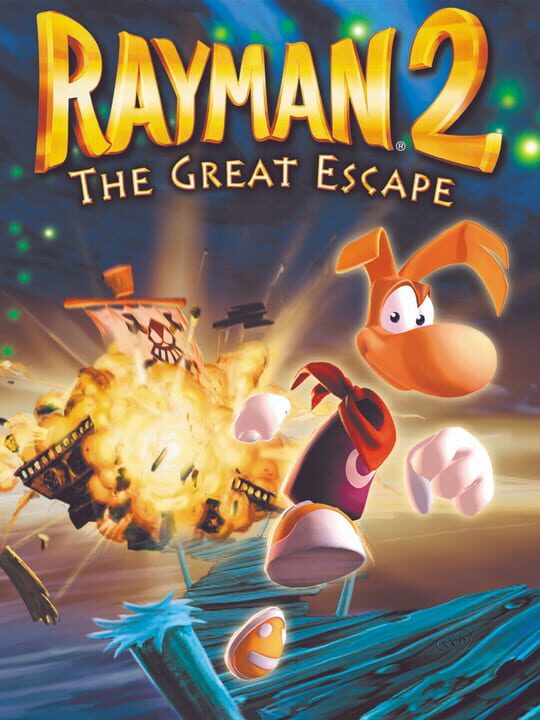
Rayman 2: The Great Escape
Main Game
RELEASED
8.0
Oct 21, 1999
Nintendo 64byUbisoft Montpellier•Gradiente
Overview:|
This 1999 Main Game, a Platform/Adventure title, casts you as Rayman, a limbless hero fighting Robot Pirates who invaded the Glade of Dreams. The core loop involves exploring vibrant 3D environments, mastering unique movement mechanics like punching and gliding, and solving puzzles to find four magic masks needed to awaken the world spirit, Polokus. Its distinctive features include a charming storybook aesthetic and challenging level design based on elemental sanctuaries. The ultimate goal is to defeat Admiral Razorbeard aboard his flying prison ship.
This 1999 release is a seminal entry in the platforming genre, translating a vibrant, storybook aesthetic into a fully realized three-dimensional world. Players step into the role of the titular limbless hero as he navigates the whimsical yet endangered Glade of Dreams. The core premise involves a sudden invasion by an army of Robot Pirates, led by the formidable Admiral Razorbeard, which shatters the world's core, severely diminishing the hero's abilities and leading to his capture.
The Premise and World
The adventure begins with the hero escaping a pirate prison ship, empowered by a magical lum. To restore balance to the Glade of Dreams, the player must embark on a quest to locate four ancient magic masks. These artifacts are necessary to awaken Polokus, the world spirit, who holds the key to repelling the invaders. The journey takes players through the Hall of Doors, a magical hub connecting diverse and elemental locations.
Core Gameplay Mechanics
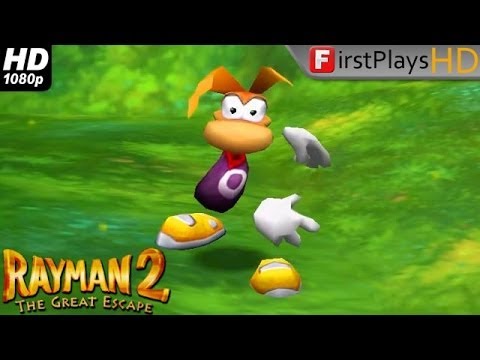
As a 3D platformer, the gameplay emphasizes exploration, precise movement, and puzzle-solving across expansive levels. The hero utilizes a unique set of abilities, including the ability to punch, helicopter his hair to glide short distances, and eventually acquire new powers as the adventure progresses. Navigating the environments often requires mastering complex jumping sequences and interacting with various characters to progress the narrative.
What makes this game unique in 3D platforming?
The game is distinguished by its imaginative enemy designs and the seamless integration of its charming, colorful visual style with challenging level design. The absence of traditional limbs for the protagonist results in a distinctive movement style that players must master to succeed in the varied sanctuaries—which are themed around the elements of water/ice, earth/stone, fire, and air.
Narrative Progression and Allies
Throughout the quest for the masks, the hero reunites with and assists friends, such as the captured Globox and the strongman Clark, who requires assistance to overcome his own ailments caused by consuming rusty pirate debris. These interactions often unlock new pathways or provide necessary tools for advancement.
Game Information Summary
This title is categorized as a main game within the Platform and Adventure genres. It was originally released on October 21, 1999, for the Nintendo 64 console. There are no officially released downloadable content packs or expansions associated with this version of the game.
What is the ultimate objective of the adventure?
After gathering the four masks and awakening Polokus, the immediate threat on land is neutralized. However, the final confrontation shifts to the skies, requiring the hero to infiltrate the Pirates' flying Prison Ship to face Admiral Razorbeard in a climactic battle against his giant mechanical creation, the Grolgoth.
Game Details
Primary Name: Rayman 2: The Great Escape
Alternative Names:
Rayman 2 (Abbreviation)
Rayman 2 N64 (Alternative title)
Type: Main Game
Series: Rayman
Developer: Ubisoft Montpellier
Publisher: Gradiente, Ubi Soft Entertainment
Engine: RenderWare
Release Information
Release Date: Oct 21, 1999
Genres & Themes
Genres: Platform, Adventure
Themes: Action, Fantasy, Comedy
Platforms
Nintendo 64
Game Modes
Perspective: Third person
Player Modes: Single-player
Game Modes: Single player
Age Ratings
ESRB:E (Everyone)
 Soren
Soren