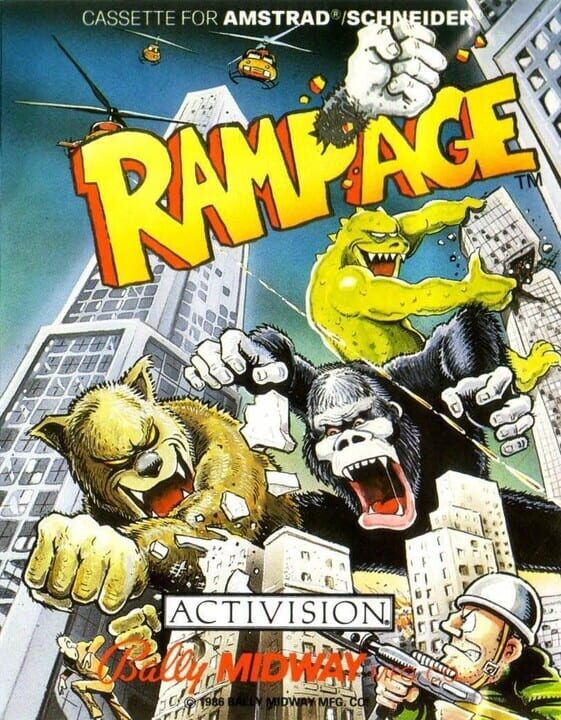
Rampage
Overview:|
As a 1988 arcade port for the Amstrad CPC, Rampage offers a core gameplay loop centered on city-wide destruction. You control a giant mutated creature—a gorilla, lizard, or werewolf—whose objective is to completely demolish every building on screen before advancing. Survival depends on strategically smashing structures while consuming food or citizens to maintain health against escalating military resistance. This version delivers the original, high-energy demolition experience native to that home computer platform.
This title is a Port of the classic 1988 arcade experience, specifically adapted for the Amstrad CPC platform. As a home conversion, its primary goal is to replicate the over-the-top action of its source material, allowing players to engage in large-scale urban demolition. The setting places you in control of massive, mutated creatures intent on leveling cities under the guise of chaotic, unrestrained destruction.
Core Gameplay Mechanics and Setting
The fundamental objective revolves around pure, unadulterated destruction. Players select one of several gigantic monsters—a gorilla, a lizard, or a werewolf—each possessing distinct characteristics. The core mechanic involves traversing detailed cityscapes, systematically smashing buildings brick by brick, and consuming the inhabitants and military personnel who oppose the rampage.
Progression is tied directly to the complete demolition of structures within a given screen before advancing to the next city layout. A critical aspect of the gameplay loop is managing the creature's health. This is replenished by consuming food items found within the rubble or by eating the citizens. Players must balance aggressive destruction with the necessity of sustenance to survive escalating military resistance, which includes tanks and helicopters.
What makes this game unique in its format?
As a port from the original coin-operated machine, this version delivers the essential, immediate gratification loop of the arcade design onto the Amstrad CPC hardware. Conversions of this era required careful adaptation to suit the home computer's capabilities, focusing on capturing the recognizable sprites and the core loop of smashing and eating. The value proposition for this specific release lies in experiencing this high-energy arcade concept on the target home system from that time period.
Platform and Release Context
This specific iteration of the game was released in 1988 for the Amstrad CPC. It is categorized under the Arcade genre, reflecting its origins as a coin-operated machine experience. It is important to note that this release is a direct adaptation; as of the current date, there are no recorded DLCs, expansions, remakes, or remasters associated with this particular 1988 Amstrad CPC version.
Survival and Progression
The game utilizes a level-based structure where success hinges on thorough destruction. Failing to clear a screen or depleting the creature's health results in the loss of a life. The difficulty increases as the military opposition becomes more persistent and better armed across subsequent cities.
Game Details
Release Information
Release Date: Dec 31, 1988
Genres & Themes
Genres: Arcade
Themes: Action, Science fiction
Platforms
Amstrad CPC
Game Modes
Perspective: Side view
Player Modes: Single-player
Game Modes: Single player
Screenshots
No screenshots available for this game.
Videos
No videos available for this game.
 Soren
Soren