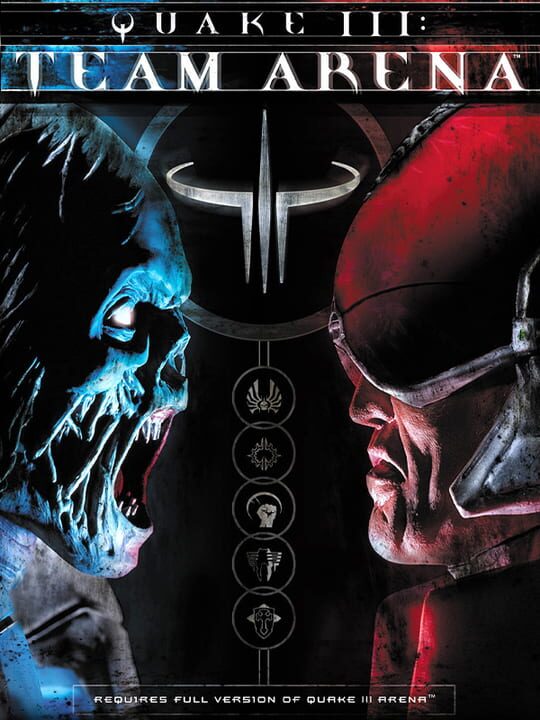
Quake III: Team Arena
Expansion
RELEASED
7.3
Dec 18, 2000
PC (Microsoft Windows)byid Software•Activision
Part of: Quake III Arena
Overview:|
As an expansion for Quake III Arena (released in 2000), this content shifts focus entirely to objective-based team combat, requiring the base game for access. It introduces four distinct, mandatory team game modes that test cooperation over individual skill, utilizing the established fast-paced shooter mechanics and arsenal across new, specialized maps. The core loop emphasizes synchronized strategy and map control rather than traditional deathmatch.
This title is an official expansion pack released in December 2000 for the core arena shooter experience, available exclusively on PC (Microsoft Windows). It shifts the focus entirely from the previous free-for-all combat structure to structured, objective-based team warfare. While building upon the established fast-paced movement and weapon arsenal of the base game, this expansion introduces a new paradigm where cooperation is mandatory for success. It is not a standalone product; access requires the original parent game.
Expansion Content and Scope
As an expansion, this content significantly bolsters the multiplayer offerings of the base game. It does not introduce a new single-player campaign or narrative storyline; instead, it focuses on refining and diversifying the competitive multiplayer environment. The core addition is the introduction of several entirely new game modes designed specifically for team play, moving beyond simple deathmatch scenarios.
New Team-Based Game Modes
The expansion features four distinct, objective-oriented modes that test squad cohesion and tactical execution. These modes force players to coordinate their efforts across the newly designed maps, emphasizing synergy between different combat roles. Success hinges on understanding and executing the specific objectives unique to each mode.
What Makes This Game Unique?
The central appeal of this expansion lies in its mandatory shift toward cooperative strategy. The atmosphere is one of unified conflict, where previously independent factions—The Fallen, Pagans, Crusaders, Intruders, and Stroggs—are aligned under a single banner to compete in these specialized team scenarios. This structure demands communication and coordinated assaults or defenses, fundamentally altering the moment-to-moment gameplay compared to the base game's focus on individual prowess.
Core Gameplay Mechanics Introduced
The primary mechanical update is the implementation of objective-based gameplay systems. Unlike the base game where the goal is typically eliminating opponents, these new modes require players to capture, defend, or escort specific points or items across the map. This necessitates strategic deployment of weapons and movement, rewarding teams that can effectively manage map control and execute synchronized maneuvers.
Integration with the Base Game
This content seamlessly integrates into the existing framework of the parent title. Players utilize the established movement mechanics, weapon set, and graphical engine. The expansion adds new maps tailored specifically to support the new team game types, ensuring that the new modes feel balanced and competitive within the established arena shooter environment.
Is this a substantial addition?
While it does not offer a traditional story mode, the addition of four entirely new, complex team-based game types, supported by dedicated map designs, represents a substantial enhancement to the game's longevity and competitive depth, focusing entirely on refining the multiplayer experience.
Game Details
Primary Name: Quake III: Team Arena
Alternative Names:
Quake 3: Team Arena (Other)
Quake III Team Arena (Other)
Quake 3 Team Arena (Other)
Quake 3: Team Arena (Other Alias)
Type: Expansion
Part of: Quake III Arena
Series: Quake
Developer: id Software
Publisher: Activision
Release Information
Release Date: Dec 18, 2000
Genres & Themes
Genres: Shooter
Themes: Action, Science fiction
Platforms
PC (Microsoft Windows)
Game Modes
Perspective: First person
Player Modes: Single-player
Game Modes: Single player, Multiplayer
Age Ratings
ESRB:M (Mature)
Videos
No videos available for this game.
 Soren
Soren