
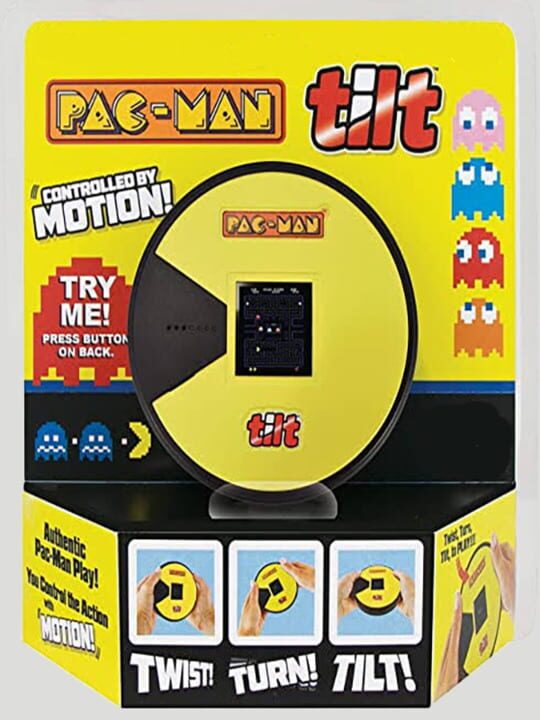
Pac-Man Tilt
Overview:|
Pac-Man Tilt, released in 2020, is an adaptation of the classic arcade maze game for handheld LCD devices. The core gameplay involves navigating mazes to consume dots while evading ghosts to achieve high scores. Its distinctive feature is the control scheme, where player movement is directly managed by physically tilting the electronic device, offering a unique, tactile interaction with the familiar objective.
This title is a dedicated electronic game, originally ported from the classic arcade experience and adapted specifically for handheld LCD devices. Released in late 2020, the core objective remains true to its source material: players navigate intricate mazes to consume all available dots while evading pursuing spectral enemies.
Core Gameplay Mechanics
The primary gameplay loop centers on maze traversal and collection under pressure. Players control the protagonist through various labyrinth layouts, aiming for high scores by clearing the board of collectibles. The fundamental challenge involves spatial awareness and timing to avoid contact with the ghosts that patrol the pathways.
Distinctive Control Scheme
What sets this iteration apart is its control input method. Instead of traditional directional buttons, movement is governed entirely by the physical orientation of the handheld unit. Players must tilt the device to influence the character's direction within the maze. This reliance on physical manipulation introduces a unique layer of dexterity and precision required to master the game's navigation.
What is the primary objective in this handheld adaptation?
The main goal is score maximization achieved by successfully consuming all pellets within the maze structure before being caught by the ghosts. Successfully clearing a maze often leads to increased difficulty in subsequent levels, typically involving faster enemy movement or more complex layouts.
Current State and Feature Set
As a port designed for dedicated electronic hardware, the experience is focused on delivering the classic arcade challenge with its specific control modification. The game modes center around the single-player pursuit of high scores and maze completion, utilizing the tilt mechanic as its defining feature.
How does the tilt control affect strategy?
The necessity of tilting the hardware means that fine, momentary adjustments are achieved through subtle shifts in the device's angle. This can lead to different strategic approaches compared to button-based controls, demanding a steady hand and an understanding of the hardware's sensitivity thresholds to execute tight turns and escapes.
Game Details
Primary Name: Pac-Man Tilt
Type: Port
Part of: Pac-Man
Developer: Super Impulse
Publisher: Super Impulse
Release Information
Release Date: Dec 31, 2020
Genres & Themes
Genres: Arcade
Themes: Action
Platforms
Handheld Electronic LCD
Game Modes
Perspective: Bird view / Isometric
Player Modes: Single-player
Game Modes: Single player
Videos
No videos available for this game.
 Soren
Soren