
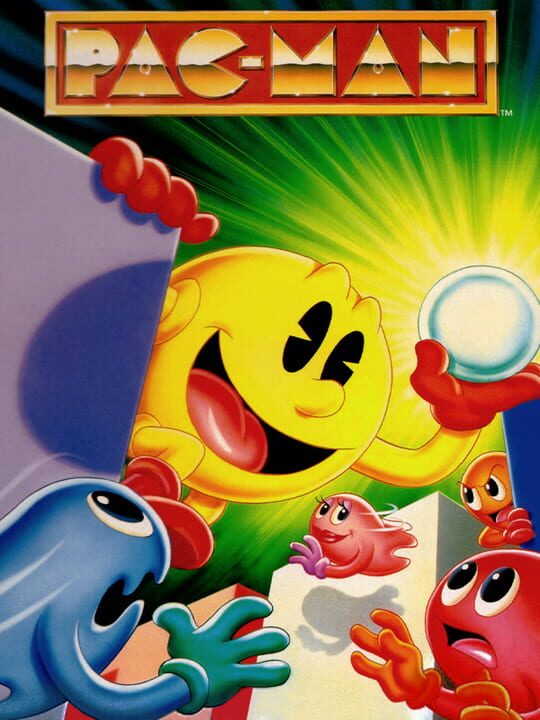
Pac-Man
Overview:|
This 1994 arcade port involves navigating mazes to consume all dots while evading pursuing ghosts; players gain temporary offensive power via power pellets. The core loop relies on pattern recognition and precise movement. Distinctive features include updated graphics and a persistent high-score table for tracking performance in this classic maze-chasing experience.
This title is a console port of the foundational arcade maze-chasing experience, originally released in 1994 for the Super Nintendo Entertainment System and Super Famicom platforms. The core gameplay loop centers on navigating intricate, fixed-layout mazes where the player controls a character tasked with consuming all the small pellets scattered throughout the environment.
The primary challenge involves evasion of four distinct, non-player-controlled antagonists (ghosts) that patrol the maze paths. Strategic consumption of Power Pellets temporarily reverses the dynamic, allowing the player to consume the ghosts for bonus points before they respawn. Success relies heavily on pattern recognition, precise movement control, and managing the limited offensive windows provided by the power-ups.
Core Gameplay Mechanics and Structure
The game operates on a score-based progression system. Players earn points for consuming standard dots, bonus items that periodically appear, and for eating the ghosts after activating a Power Pellet. The game continues until the player loses all available lives, typically through contact with an active ghost.
Distinctive Features of this Version
Compared to its arcade predecessor, this specific 1994 release incorporates visual enhancements, presenting the classic maze action with updated graphical fidelity suitable for the target console hardware. A notable addition is the inclusion of a persistent high-score table, allowing players to track and compete against recorded achievements across multiple play sessions.
What defines the maze navigation experience?
The environment is characterized by fixed, interconnected pathways. Movement is strictly directional, requiring players to commit to a turn before reaching an intersection. Mastering the predictable, yet complex, movement patterns of the pursuing enemies is essential for survival and maximizing score potential. The game modes are focused entirely on this single-player, high-score pursuit.
Current State and Community Reception
As a classic title, the gameplay remains static and defined by its original design principles. Community reception generally centers on nostalgia and the fidelity of this specific port to the original arcade blueprint. Recent discussions within enthusiast communities often focus on speed-running techniques and optimizing routes to achieve maximum scores within the established level structure.
Game Details
Release Information
Release Date: Apr 6, 1994
Genres & Themes
Genres: Arcade
Themes: Action
Platforms
Super Nintendo Entertainment SystemSuper Famicom
Game Modes
Perspective: Bird view / Isometric
Player Modes: Single-player
Game Modes: Single player
Screenshots
No screenshots available for this game.
Videos
No videos available for this game.
 Soren
Soren