
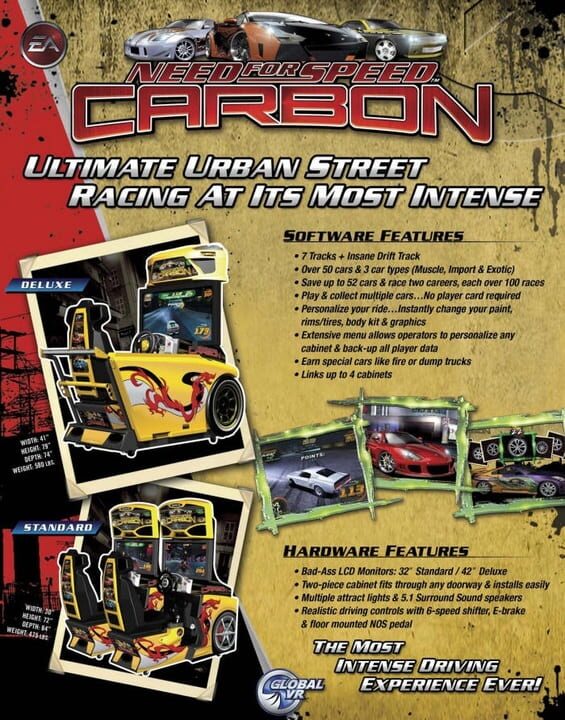
Need for Speed: Carbon
Overview:|
Need for Speed: Carbon is an arcade racing title, originally released in 2008. The core gameplay loop centers on immediate, high-speed street racing where players compete to win races through streamlined controls optimized for arcade cabinet play. This version emphasizes accessible, fast-paced action suitable for shorter gaming sessions.
This title is an arcade iteration of a street racing simulation, originally launched in 2008. The core experience centers on high-speed, competitive racing within structured environments. Players engage in immediate, accessible racing action where the primary objective is to outmaneuver opponents and secure first place across various circuit layouts.
Core Gameplay Mechanics
The gameplay loop is built around short, intense races designed specifically for arcade hardware. Controls are streamlined to prioritize quick reaction times and accessible handling, focusing on the immediate thrill of speed rather than complex simulation physics. Success in races yields progression, allowing access to new tracks and competitive tiers within the arcade environment.
Setting and Progression
The game places the player within a world centered entirely on competitive street racing culture. While the narrative structure is simplified for the arcade format, the progression system is tied directly to performance in these high-stakes events. Players advance by mastering the available tracks and consistently achieving top finishes against AI competitors.
What is the primary focus of this version?
The distinctive feature of this release is its adaptation for the arcade platform. This means the experience is optimized for shorter play sessions and immediate engagement, contrasting with longer-form console or PC versions. The emphasis is squarely on accessible, fast-paced racing.
Key Features of the Arcade Experience
The game features a selection of race types tailored for quick competition. The physics model is tuned for immediate fun, favoring aggressive driving and skillful navigation of the course layout over deep vehicle customization or extensive open-world exploration.
How does the control scheme impact play?
The control scheme is engineered for immediate player input, ensuring that the barrier to entry for participating in a race is low. This design choice directly supports the arcade environment's need for rapid turnover between competitive events.
Current State and Longevity
As a dedicated arcade port released in 2008, the game's current state is defined by its fixed content and hardware dependency. Updates or changes are typically limited to maintenance or configuration adjustments on the physical arcade units themselves, rather than ongoing digital content patches.
Game Details
Primary Name: Need for Speed: Carbon
Type: Port
Part of: Need for Speed: Carbon
Series: Need for Speed
Developer: Global VR
Publisher: Global VR
Release Information
Release Date: Dec 31, 2008
Genres & Themes
Genres: Racing
Themes: Action
Platforms
Arcade
Game Modes
Perspective: Third person
Player Modes: Single-player
Game Modes: Single player

 Soren
Soren