
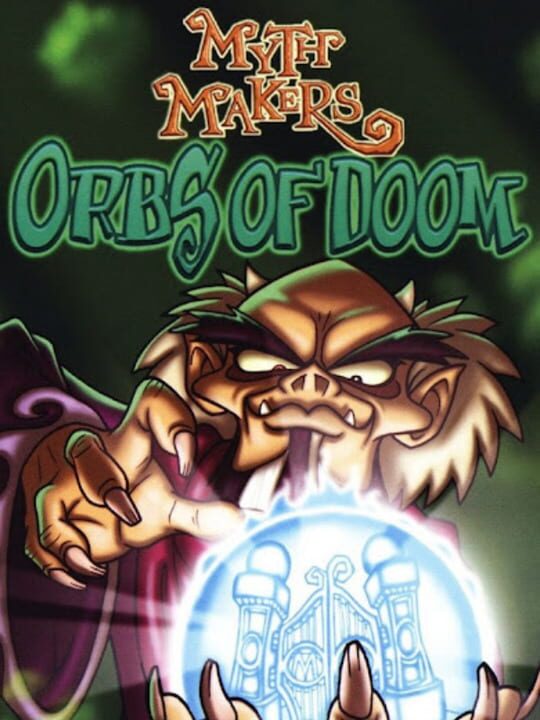
Myth Makers: Orbs of Doom
Main Game
RELEASED
Oct 26, 2007
PlayStation 2WiibyData Design Interactive•Bold Games
Overview:|
Myth Makers: Orbs of Doom, a 2007 puzzle game for PS2 and Wii, tasks players with guiding the trapped Myth Makers as they roll through 40 brain-teasing levels across five environments to stop the villain Sinister Rebus. The core gameplay involves spatial reasoning and momentum control to solve environmental challenges inherent in each stage, functioning as a complete, standalone adventure.
This title, originally released in 2007, is a Main Game categorized within the Puzzle genre, available on the PlayStation 2 and Wii platforms. The core premise centers on the Myth Makers, heroes who have been imprisoned within eight magical artifacts known as the Orbs of Doom by the villainous Sinister Rebus. The objective is for these trapped heroes to navigate the perplexing landscape of the Myth Realm, solve environmental challenges, and ultimately free themselves from the villain's clutches. The experience is structured across 40 distinct, brain-teasing levels set within five visually distinct environments.
Core Gameplay Mechanics
The gameplay loop revolves around navigating these puzzling environments. Players must utilize the unique abilities of the Myth Makers to progress. As the heroes are trapped inside rolling orbs, the primary mechanic involves movement, momentum, and spatial reasoning to traverse the stages. This requires precise control to manage the rolling motion and avoid hazards.
Success in the game requires careful planning and execution to overcome the obstacles presented in each of the 40 stages. The design emphasizes puzzle-solving integrated directly into the movement system, demanding players master the physics of their orb-bound forms.
What is the setting and atmosphere of this adventure?
The game transports players to the Myth Realm, a setting characterized by five different, lavish environments that serve as the backdrop for the 40 levels. The atmosphere is driven by the central conflict: the heroes are physically constrained within the Orbs of Doom, adding a layer of urgency to the puzzle-solving as they attempt to thwart Sinister Rebus's takeover plans.
What content is included in the base game?
This release functions as a complete, standalone experience. There are no officially documented downloadable content packs (DLCs) or expansions available for this title, meaning all 40 levels are present in the initial package.
How is progression structured?
Progression is linear, moving through the 40 levels which are grouped across the five themed areas of the Myth Realm. Each level presents a new configuration of puzzles that must be solved to advance the narrative of freeing the Myth Makers.
What makes the movement system distinctive?
The distinctive feature lies in the constraint of the heroes being trapped within rolling orbs. This mechanic transforms standard level traversal into a physics-based puzzle, where understanding inertia and trajectory is key to reaching the goal of each stage.
Game Details
Primary Name: Myth Makers: Orbs of Doom
Type: Main Game
Series: Myth Makers
Developer: Data Design Interactive
Publisher: Bold Games, Popcorn Arcade
Release Information
Release Date: Oct 26, 2007
Genres & Themes
Genres: Puzzle
Themes: Action
Platforms
PlayStation 2Wii
Game Modes
Perspective: Third person
Player Modes: Single-player
Game Modes: Single player, Split screen
Age Ratings
ESRB:E (Everyone)
Videos
No videos available for this game.
 Soren
Soren