
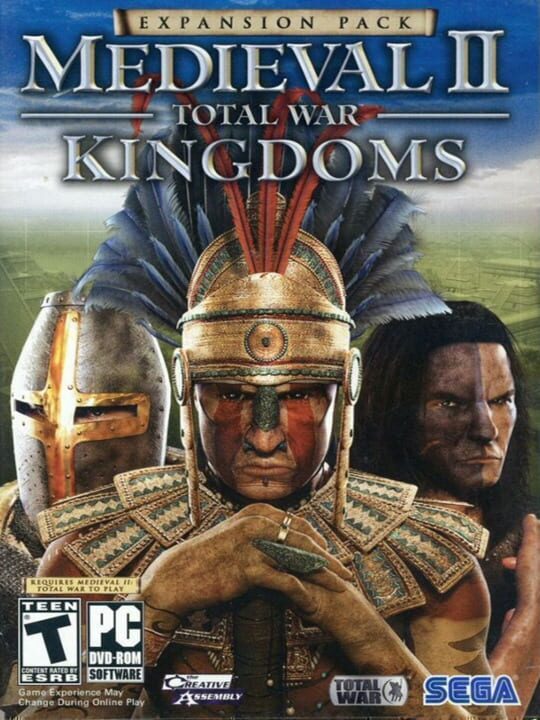
Medieval II: Total War - Kingdoms
Expansion
RELEASED
7.7
Aug 28, 2007
LinuxPC (Microsoft Windows)+1byThe Creative Assembly•Feral Interactive
Part of: Medieval II: Total War
Overview:|
As a substantial expansion requiring the base game, Medieval II: Total War Kingdoms (2007) adds four new, detailed campaigns set across the British Isles, Teutonic Europe, the Middle East (Crusades), and the Americas. You command 13 new factions, utilize over 110 new units, and explore vast new maps, adding up to 80 hours of strategy gameplay. A key feature is the introduction of Hotseat multiplayer for campaign play on a single PC.
This title is the official expansion pack for the acclaimed strategy game, Medieval II: Total War. Released in 2007, it significantly broadens the scope of the original experience by introducing four distinct, fully realized campaigns centered on new geographical regions. This content requires the base game to play and offers a massive injection of new strategic material, estimated to provide up to 80 hours of additional gameplay.
What New Worlds Await Exploration?
The expansion is structured around four new, detailed campaign maps, each presenting a unique historical setting and specific set of strategic challenges. These distinct theaters of war include:
- The British Isles Campaign: Focusing on the islands of Great Britain and Ireland.
- The Teutonic Campaign: Centered on Northern Europe, involving religious expansion and territorial conflicts.
- The Crusades Campaign: Shifting the focus to the Middle East, emphasizing the religious wars of that era.
- The New World Campaign: This is a major addition, opening up vast tracts of land in both North and South America for conquest, an area only briefly introduced in the original title.
Across these new maps, the expansion introduces 13 entirely new playable factions, over 110 new unit types for players to command, and 50 new building types to construct, substantially increasing the strategic depth available.
Core Gameplay Enhancements and New Mechanics
The core gameplay loop remains the established blend of turn-based grand strategy management on the world map and real-time tactical battles. However, the new settings introduce specific mechanics. The inclusion of New World factions, such as the Aztecs, Apaches, and Mayans, brings unique military structures and cultural dynamics directly into the strategic layer.
What New Multiplayer Options Are Available?
A notable addition for players engaging with others is the introduction of new multiplayer modes. Beyond standard skirmishes, the expansion features Hotseat multiplayer for the first time in the series. This allows two players to engage in competitive campaign games using the new content on a single computer.
How Substantial is the Content Addition?
The scope of this addition is considerable, rivaling the amount of content found in a full standalone title rather than a minor add-on. By focusing on four distinct historical theaters, it provides varied strategic puzzles and unit compositions, effectively multiplying the replayability of the core strategic and tactical engine of the base game.
Platform Availability
This content is available across Linux, PC (Microsoft Windows), and Mac platforms. As of the current date, this release stands as the definitive expansion for the base game, integrating all its new features directly into the established framework.
Game Details
Primary Name: Medieval II: Total War - Kingdoms
Alternative Names:
Total War: Medieval II - Kingdoms
Medieval 2: Total War - Kingdoms
Type: Expansion
Part of: Medieval II: Total War
Developer: The Creative Assembly
Publisher: Feral Interactive, Sega
Release Information
Release Date: Aug 28, 2007
Genres & Themes
Genres: Strategy, Turn-based strategy (TBS), Tactical
Themes: Historical
Platforms
LinuxPC (Microsoft Windows)Mac
Game Modes
Perspective: Bird view / Isometric
Player Modes: Single-player
Game Modes: Single player, Multiplayer
Age Ratings
ESRB:T (Teen)
 Soren
Soren