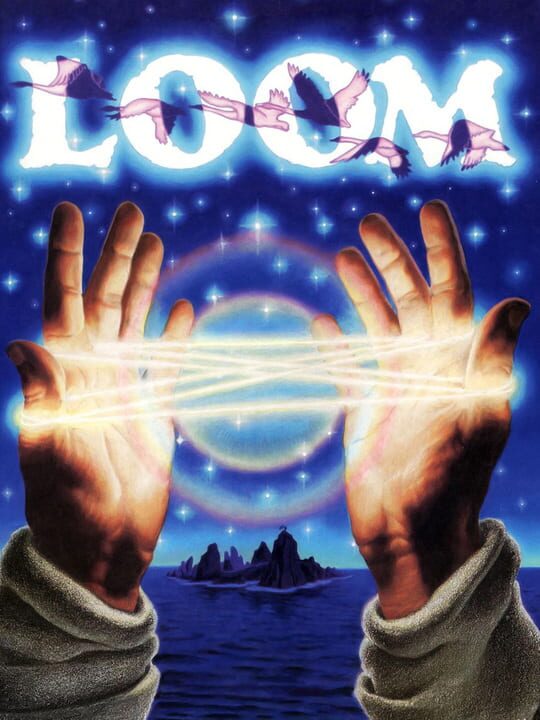
Loom
Main Game
RELEASED
7.9
Jan 1, 1990
Turbografx-16/PC Engine CDDOS+6byLucasfilm Games•LucasArts
Overview:|
Loom is a classic 1990 point-and-click adventure game where you play as Bobbin, the last Weaver, tasked with saving reality after his Guild vanishes. The core gameplay loop centers on learning and playing short musical phrases, called "drafts," on a magical distaff to cast spells, solve environmental puzzles, and influence the world. This unique focus on auditory sequence memorization, rather than traditional inventory puzzles, defines its distinctive mechanics. The story involves navigating a world of powerful guilds in a distant future to confront a growing cosmic threat.
This classic adventure title, first released in 1990, is set in a distant future following an age ruled by dragons, where civilization is organized around powerful, knowledge-controlling Guilds. Players assume the role of Bobbin Threadbare, the sole surviving apprentice of the secretive Weaver Guild. After a mysterious event eradicates his people, Bobbin must embark on a quest to uncover the truth behind their disappearance and prevent the very fabric of reality from unraveling. The setting merges high fantasy elements with a unique, mystical technological backdrop centered on manipulating existence itself.
Core Gameplay Mechanics: The Art of Weaving
This experience blends point-and-click adventure structure with highly distinct puzzle mechanics. Unlike many contemporaries that relied heavily on combining physical inventory items, the central interaction method revolves around music and magical notation.
The Weavers practice their craft by manipulating "drafts"—short, distinct musical phrases played using a magical distaff. As Bobbin progresses, he learns these sequences, often by observing others or discovering them within the environment. The core gameplay loop requires the player to identify the necessary magical effect—such as opening a barrier, repairing an object, or transforming a being—and then accurately reproduce the corresponding musical draft using the distaff interface.
The Musical Spellcasting System
Each draft is a specific sequence of musical notes. Players must memorize these sequences for later use. Successfully playing the correct pattern applies the corresponding spell or effect to the world, serving as the primary method for solving environmental puzzles and advancing the narrative. This system introduces elements of puzzle solving and sequence memory, demanding auditory recognition alongside traditional adventure game exploration.
Setting and Narrative Context
The world is organized into powerful factions, including the Blacksmiths, Shepherds, and Clerics, each guarding specific secrets. Bobbin’s quest forces him off the isolated Weaver island, leading him to interact with these other guilds while confronting forces seeking to exploit the resulting chaos.
The overarching narrative explores themes of destiny, hidden knowledge, and the burden of power. It is important to note that significant context for the world and the events leading up to Bobbin's seventeenth birthday—where the game begins—was established in a supplemental 30-minute audio drama released concurrently with the game.
What makes this game unique in the adventure genre?
The defining feature is the musical spellcasting system. By substituting traditional item-based inventory puzzles with the memorization and execution of musical patterns, the game presents a unique cognitive challenge based on auditory recall and sequence accuracy, distinguishing it significantly from standard adventure game paradigms.
Platform Availability and Current State
Originally launched in 1990, this title has been ported across numerous systems, including DOS, Amiga, Mac, Atari ST/STE, FM Towns, and the Turbografx-16/PC Engine CD. It remains playable on modern systems such as Microsoft Windows and Linux through various compatibility methods.
Community Reception and Longevity
As a foundational title from the era of Lucasfilm Games, the game is generally recognized for its innovative approach to puzzle design. While it is a complete, standalone experience with no official expansions or DLC, its legacy rests on its unique mechanics rather than ongoing content updates.
Game Details
Primary Name: Loom
Alternative Names:
紗之器 (Chinese title)
האורגים (Hebrew title)
Loom (1990) (Alternative title)
Loom.exe (Windows Executable)
Type: Main Game
Developer: Lucasfilm Games
Publisher: LucasArts, Lucasfilm Games, U.S. Gold
Engine: SCUMM
Release Information
Release Date: Jan 1, 1990
Genres & Themes
Genres: Point-and-click, Puzzle, Simulator, Strategy, Adventure
Themes: Fantasy, Historical
Platforms
Turbografx-16/PC Engine CDDOSLinuxPC (Microsoft Windows)FM TownsAmigaAtari ST/STEMac
Game Modes
Perspective: Third person
Player Modes: Single-player
Game Modes: Single player

 Soren
Soren