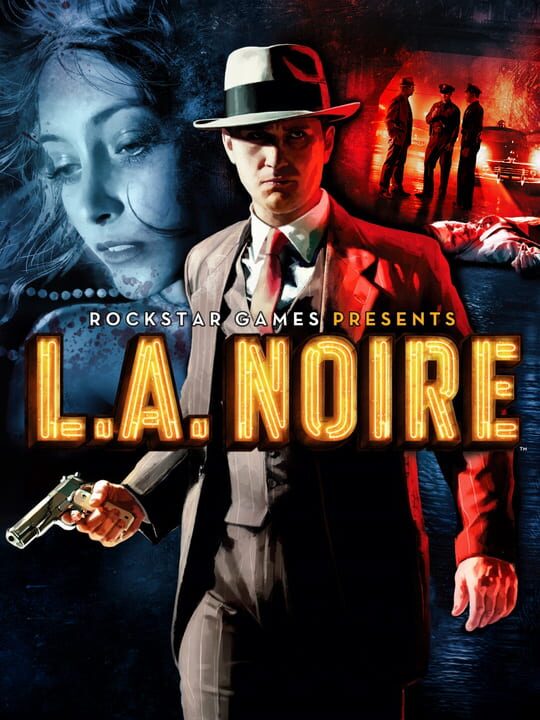
L.A. Noire
Main Game
RELEASED
8.2
May 17, 2011
Xbox 360PC (Microsoft Windows)+2byTeam Bondi•Take-Two Interactive
Overview:|
This is a neo-noir detective action-adventure game, originally released in 2011, set in 1947 Los Angeles. As an LAPD officer, your core loop involves investigating crime scenes for clues, following leads, and interrogating suspects across five police divisions. Its distinctive feature is the reliance on advanced facial capture technology, requiring players to analyze subtle expressions during questioning to determine if a suspect is telling the truth, directly impacting case outcomes. The presentation offers a classic film noir aesthetic, including a black-and-white visual option.
This is a neo-noir detective action-adventure game set in the sprawling, corrupt landscape of Los Angeles in 1947, during the post-war boom of Hollywood's Golden Age. Players step into the shoes of Cole Phelps, an officer in the Los Angeles Police Department, tasked with navigating a city rife with escalating crime, from arson and racketeering to brutal murders. The core experience centers on climbing the ranks by solving a variety of complex cases across five distinct police divisions, demanding sharp observational skills and keen deductive reasoning.
Core Gameplay and Mechanics
The gameplay loop revolves around meticulous investigation, clue gathering, and critical interrogation. Players must thoroughly examine crime scenes to uncover physical evidence that will inform their next steps. Following leads takes the player through the atmospheric streets of 1940s L.A., interacting with witnesses and suspects.
The most distinctive mechanic involves interrogations. Success hinges on the player's ability to read non-verbal cues from suspects. By observing facial expressions and body language, players must choose the correct approach—Truth, Doubt, or Lie—to elicit information. The accuracy of these choices directly impacts how much of the case's narrative is revealed, influencing the outcome of the investigation.
Atmosphere and Presentation
The game heavily draws inspiration from the aesthetic and thematic elements of classic film noir. This is reflected in the game's visual style, which features a distinctive color palette reminiscent of the era, and even offers an optional black-and-white mode for purists seeking an authentic cinematic feel.
What makes this game unique in the detective genre?
The primary unique selling point lies in the sophisticated facial capture technology utilized to render realistic human expressions during interrogations. This system elevates the detective work beyond simple dialogue trees, forcing players to engage in psychological profiling to determine if a suspect is being truthful.
Furthermore, the narrative weaves in elements inspired by real-life crimes reported in the Los Angeles media of 1947, grounding the fictional police work in a recognizable, yet stylized, historical context.
What is the story premise?
Amid the post-war boom of Hollywood's Golden Age, Cole Phelps is an LAPD detective thrown headfirst into a city drowning in its own success. Corruption is rampant, the drug trade is exploding, and murder rates are at an all-time high. In his fight to climb the ranks and do what's right, Phelps must unravel the truth behind a string of arson attacks, racketeering conspiracies and brutal murders, battling the L.A. underworld and even members of his own department to uncover a secret that could shake the city to its rotten core.
Platform Availability and Additional Content
Initially released in 2011 for the PlayStation 3 and Xbox 360, the game later became available on PC (Microsoft Windows). A remastered version is also available for modern platforms, including SteamVR support.
The main game experience is supplemented by several downloadable content (DLC) packages, which typically introduce additional cases that expand upon the overarching narrative or offer new challenges outside the main career progression.
Game Details
Primary Name: L.A. Noire
Alternative Names:
LA Noir (Other Alias)
L.A. Noir (Other Alias)
Los Angeles Noire (Other Alias)
LA Noire (Other Alias)
Type: Main Game
Developer: Team Bondi, Rockstar North, Rockstar Leeds
Publisher: Take-Two Interactive, Rockstar Games
Release Information
Release Date: May 17, 2011
Genres & Themes
Genres: Strategy, Adventure
Themes: Sandbox, Open world, Mystery, Action, Thriller, Historical
Platforms
Xbox 360PC (Microsoft Windows)SteamVRPlayStation 3
Game Modes
Perspective: Third person
Player Modes: Single-player
Game Modes: Single player
Age Ratings
ESRB:M (Mature)
PEGI:18+
Extreme violence - Multiple, motiveless killing - Violence towards defenceless people - Descriptions of criminal techniques - Strong language
CERO:Z (18+)




 Soren
Soren