
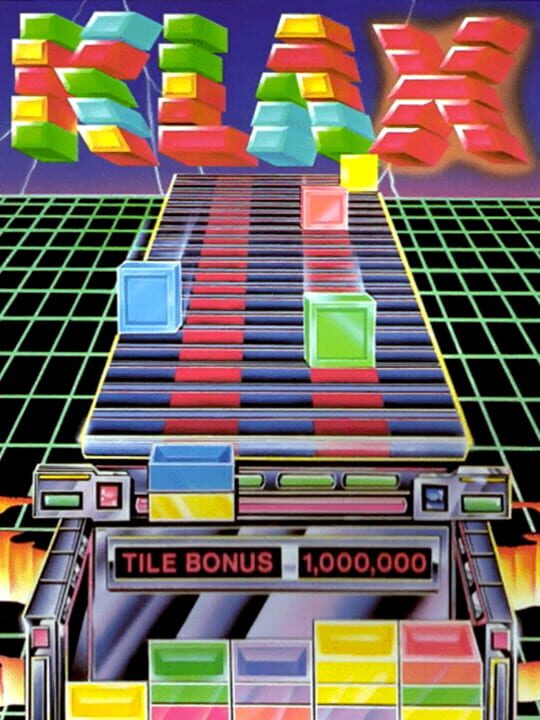
Klax
Overview:|
This is a 1990 port of the classic arcade puzzle game to the Atari 2600, representing one of the system's final official releases. Gameplay centers on a pure, high-score-chasing loop where you catch falling blocks from a conveyor belt and strategically arrange them to form matches of three or more horizontally, vertically, or diagonally. As a port, the experience focuses entirely on reactive pattern matching and spatial strategy under increasing speed, offering the core arcade challenge without any narrative elements.
This title is a direct port of the popular arcade experience, brought to the Atari 2600 console in 1990. As a port, it aims to deliver the core mechanics and challenge of its source material onto a different hardware platform, representing one of the final official software releases for that system. The game centers entirely on fast-paced puzzle-solving and strategic arrangement, offering a pure arcade challenge without any narrative setting or complex world-building.
Core Gameplay Mechanics and Strategy
The fundamental experience revolves around sorting falling blocks. Players must catch blocks descending on a conveyor belt and strategically place them into a holding area. The objective is to arrange these blocks into matching sets of three or more, either horizontally, vertically, or diagonally, to clear them from the board. Successfully making these matches scores points and clears space, while failing to manage the blocks results in them piling up.
The strategy lies in anticipating the sequence of incoming blocks and planning placements several moves ahead to create cascading clears. This requires quick reflexes combined with spatial reasoning under increasing pressure as the speed of the falling pieces escalates.
What defines this puzzle experience?
The defining feature of this game is its emphasis on continuous, reactive pattern matching. Unlike some puzzle games that rely on rotating pieces, this version focuses on catching and positioning pre-determined shapes as they arrive. The challenge intensifies as the game progresses, demanding higher levels of concentration and efficiency to maintain control of the playing field.
Platform and Release Context
Originally released on June 4, 1990, this version was developed for the Atari 2600. Being a port, its value proposition centers on experiencing the established arcade formula on a home console from that era.
Available Content Status
This specific release contains no downloadable content (DLC) or official expansions. The content delivered upon release constitutes the complete package for this Atari 2600 iteration.
How does this port relate to the original arcade game?
As a port, the primary goal is to translate the arcade's addictive, high-score-chasing loop to the Atari 2600 hardware. While hardware limitations may affect graphical fidelity or precise timing compared to the original arcade cabinet, the essential puzzle-solving loop—catching, sorting, and matching—remains the central focus of the gameplay.
Game Details
Release Information
Release Date: Jun 4, 1990
Genres & Themes
Genres: Puzzle, Strategy, Arcade
Platforms
Atari 2600
Game Modes
Perspective: Side view
Player Modes: Single-player
Game Modes: Single player
Videos
No videos available for this game.
 Soren
Soren