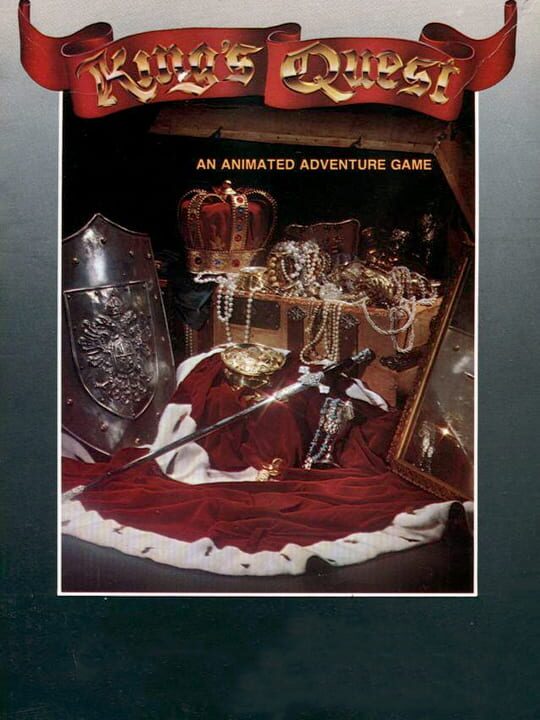
King's Quest: Quest for the Crown
Main Game
RELEASED
6.9
May 10, 1984
DOSPC (Microsoft Windows)+6bySierra On-Line•Activision
Overview:|
As the foundational Main Game in its series, this 1984 puzzle/adventure title casts you as Sir Graham, a knight tasked by King Edward to recover three stolen magical treasures to save the failing kingdom of Daventry. Gameplay centers on exploring a fairy tale world, collecting necessary items, and solving intricate puzzles using text commands to interact with the environment. It pioneered the graphic adventure genre by merging visuals with typed input, establishing the core fantasy setting and puzzle mechanics that defined the franchise.
This is the foundational title in a celebrated adventure series, first released in 1984. Players step into the role of Sir Graham, a brave knight serving the ailing King Edward of Daventry. The kingdom has fallen on hard times following a series of misfortunes involving stolen magical artifacts. Graham is tasked with a perilous quest: to venture out into a world inspired by classic fairy tales and recover three lost treasures essential to restoring Daventry's prosperity and securing its future. The game blends exploration, item collection, and intricate puzzle-solving within its fantasy setting.
Core Gameplay Mechanics and Genre Pioneering
This title is recognized as a significant entry in the graphic adventure genre, representing an early fusion of visual presentation and player input. Gameplay revolves around navigating Sir Graham through various distinct locations across the realm. Players interact with the environment and non-player characters by inputting text commands, which direct Graham's actions, such as examining objects, picking up items, or speaking to inhabitants. Success hinges on understanding the environment and creatively applying collected items to overcome obstacles and solve complex, often logic-based, puzzles.
What made this game a genre pioneer?
The game established many of the core thematic and mechanical elements that would define the franchise for years to come. It introduced the central character of Sir Graham, whose journey forms the backbone of the series' lore. The atmosphere is steeped in traditional fantasy tropes, featuring encounters with various creatures and magical elements that players must navigate using wit rather than combat prowess.
Setting and Premise: The Fall of Daventry
The narrative begins with the tragic decline of the once-thriving Kingdom of Daventry. After a series of deceptions—including the loss of a Magic Mirror, a King's Shield, and a self-refilling chest of gold—the kingdom is left impoverished and vulnerable. King Edward, seeing a resemblance between Sir Graham and the gallant young man foretold in the lost mirror, entrusts the knight with the monumental task of retrieving these powerful artifacts before his own end. The atmosphere is one of high fantasy adventure mixed with the urgency of saving a kingdom from ruin.
What are the primary genres of this adventure?
The game is categorized primarily as an Adventure title, heavily emphasizing Puzzle elements. It requires careful observation and inventory management to progress through the story.
Platform Availability and Legacy
As a main game title, it saw wide distribution across early computing systems. It was initially available on platforms such as DOS and the Apple II, later seeing releases across systems including the Amiga, Atari ST, and Mac, as well as console ports like the Sega Master System/Mark III. As the inaugural entry in the series, there are no official downloadable content packs or expansions associated with this original release.
Game Details
Primary Name: King's Quest: Quest for the Crown
Alternative Names:
KQ1 (Acronym)
King's Quest™ (Other Alias)
King's Quest 1 (Other Alias)
Type: Main Game
Series: King's Quest
Developer: Sierra On-Line
Publisher: Activision, Sierra On-Line, IBM, Parker Brothers
Engine: AGI
Release Information
Release Date: May 10, 1984
Genres & Themes
Genres: Puzzle, Adventure
Themes: Fantasy
Platforms
DOSPC (Microsoft Windows)Apple IIGSSega Master System/Mark IIIAmigaAtari ST/STEApple IIMac
Game Modes
Perspective: Side view
Player Modes: Single-player
Game Modes: Single player
 Soren
Soren