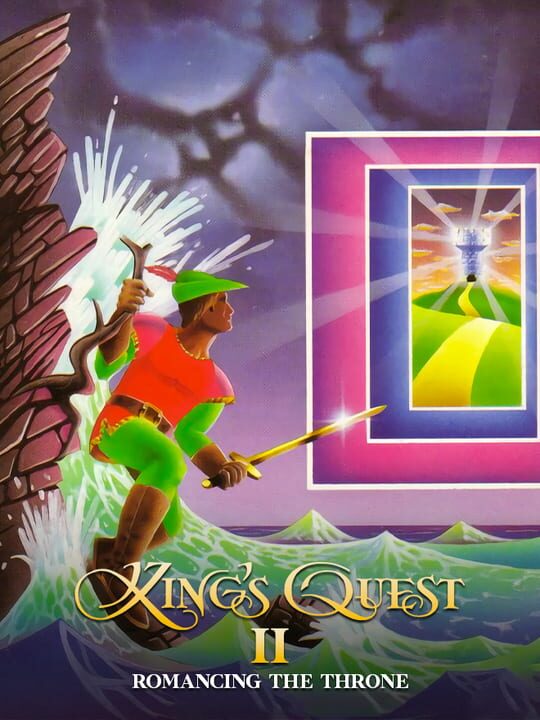
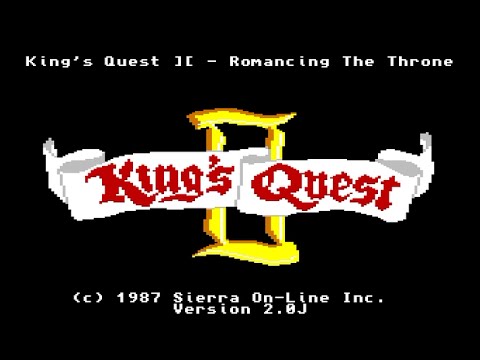
King's Quest II: Romancing the Throne
Main Game
RELEASED
5.7
Jun 20, 1985
DOSApple IIGS+4bySierra On-Line
Overview:|
As a classic 1985 main adventure game, King's Quest II: Romancing the Throne casts you as King Graham, who seeks a bride in the land of Kolyma to rescue the imprisoned Valanice. Gameplay relies on point-and-click mechanics, inventory management, and solving fairy-tale inspired puzzles across a larger world than its predecessor. This installment is notable for introducing Valanice, a key figure in the ongoing saga, and it has since received a remake.
This classic adventure title, originally released in 1985, casts players as King Graham, the established ruler of Daventry. Having secured his kingdom, Graham now embarks on a personal quest: to find a suitable bride. This journey leads him to the distant land of Kolyma, where a maiden named Valanice is held captive in a quartz tower by an evil witch. The core experience involves guiding Graham through this fairy-tale inspired world, solving intricate puzzles, and interacting with a variety of characters and creatures drawn from folklore. As a foundational entry in its long-running series, this game significantly expands upon the world exploration and puzzle complexity established in its predecessor, setting the stage for future narrative developments within the saga.
Core Gameplay Mechanics and Exploration
The gameplay centers on the traditional point-and-click adventure format, requiring players to navigate environments, examine objects, and utilize an inventory system to overcome obstacles. Success hinges on careful observation and logical deduction to solve environmental puzzles. Players must manage their interactions with the world, as certain actions or item usages can lead to unexpected consequences within the narrative structure.
What is the setting and atmosphere like?
The atmosphere is deeply rooted in classic European fairy tales and folklore. Players will traverse diverse landscapes and encounter familiar archetypes, from helpful sprites to menacing beasts, all contributing to a rich, storybook environment where magic and peril coexist. The game utilizes a parser-based interaction system combined with visual navigation across its various screens.
Game Structure and Content
This title functions as a complete, standalone Main Game experience. It was made available across numerous early computing platforms, including DOS, Apple IIGS, Amiga, Mac, and Atari ST/STE, reflecting its broad initial release strategy in the mid-1980s.
Are there any additional downloadable contents or expansions available for this game?
There are no official DLCs or expansions associated with this specific release. The content provided upon its initial launch constitutes the complete experience. However, it is noted that the game has received one remake in its history, offering a modernized interpretation of the original adventure.
How does this installment advance the series?
This installment is significant as it introduces Valanice, a character who becomes central to the ongoing narrative of the series, solidifying the personal stakes for the protagonist beyond simple kingdom management. The world map is larger than in the previous entry, offering more areas to explore and a greater number of interconnected challenges to unravel. The puzzle complexity is notably more involved than in the first installment.
Game Details
Primary Name: King's Quest II: Romancing the Throne
Alternative Names:
KQ2 (Acronym)
King's Quest 2 (Other Alias)
Type: Main Game
Series: King's Quest
Developer: Sierra On-Line
Publisher: Sierra On-Line
Engine: AGI
Release Information
Release Date: Jun 20, 1985
Genres & Themes
Genres: Point-and-click, Puzzle, Adventure
Themes: Fantasy
Platforms
DOSApple IIGSAmigaAtari ST/STEApple IIMac
Game Modes
Perspective: Side view
Player Modes: Single-player
Game Modes: Single player
 Soren
Soren