
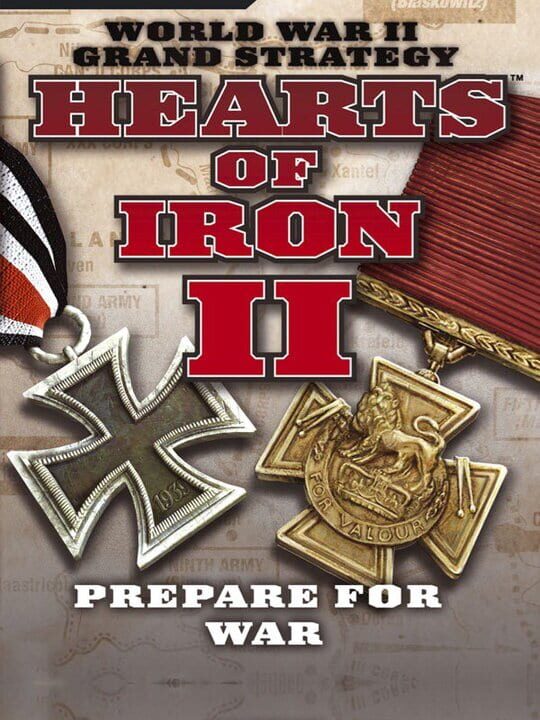
Hearts of Iron II
Main Game
RELEASED
8.6
Jan 4, 2005
PC (Microsoft Windows)byParadox Interactive
Overview:|
As a 2005 Real Time Strategy/Strategy main game, you rule one of 175 nations through World War II and potentially World War III. The core loop involves deep management of industry, technology, diplomacy, and military forces. Success relies on long-term strategic planning rather than fast tactics. A distinctive feature is the scope, allowing the conflict to escalate past 1945 into a new global standoff between major powers, demanding constant adaptation to the shifting geopolitical landscape.
This is a grand strategy Real Time Strategy game originally released in 2005 for PC (Microsoft Windows). The core premise plunges players into the turbulent mid-20th century, allowing them to assume the role of the supreme leader of one of 175 selectable nations. The objective involves navigating the complex political, industrial, and military landscapes spanning World War II and potentially extending into a hypothetical World War III scenario. The atmosphere is one of intense global conflict, where strategic decisions made at the national level directly impact the fate of millions on the battlefield.
Core Gameplay and Mechanics
The gameplay loop centers on managing every facet of a nation's existence during a period of total war. Players must simultaneously balance industrial production, technological research, diplomatic maneuvering, and military command. This requires designing and building specific military units—from infantry divisions to complex naval fleets—and positioning them strategically across the globe.
A key feature is the deep simulation of military logistics and command structure. Success hinges less on rapid tactical execution and more on long-term planning, resource allocation, and understanding the capabilities and limitations of various military doctrines. Players manage everything from oil supplies and raw material acquisition to the specific composition of their armored divisions and the deployment of intelligence assets.
The Global Conflict Setting
The narrative framework begins with the historical context of World War II. However, the scope extends beyond the historical conclusion of 1945. Depending on the outcomes of the initial war, the game transitions into a hypothetical World War III scenario, pitting the major remaining powers—such as the Western Allies and the Soviet alliance—against each other for global dominance. This potential continuation offers a unique strategic challenge beyond the known historical timeline.
What makes this game unique in its genre?
The sheer scale of control offered to the player sets this title apart. It is not merely a war game; it is a comprehensive national simulator focused on the era of global conflict. The focus remains firmly on strategic depth over moment-to-moment tactical execution, demanding comprehensive management of the entire state apparatus.
Available Content and Expansions
The base game provides the complete World War II and subsequent conflict experience. Furthermore, the title has been supported by several significant expansion packs, which add further layers of complexity and content to the core simulation, enhancing the depth of the strategic systems.
Can I play past World War II?
Yes. A central feature of the design is the possibility of the conflict escalating beyond the historical conclusion of World War II in 1945. Should the initial war conclude in a specific manner, the game world can shift into a Cold War-style confrontation between the remaining superpowers, demanding entirely new strategic priorities from the player.
Game Details
Primary Name: Hearts of Iron II
Alternative Names:
HoI2, Hearts 2, HoI II, Hearts of Iron 2 (Other)
Hearts of Iron 2 (Other Alias)
HoI II (Other Alias)
Hearts 2 (Other Alias)
HoI2 (Other Alias)
Type: Main Game
Series: Hearts of Iron
Developer: Paradox Interactive
Publisher: Paradox Interactive
Release Information
Release Date: Jan 4, 2005
Genres & Themes
Genres: Real Time Strategy (RTS), Strategy
Themes: Historical
Platforms
PC (Microsoft Windows)
Game Modes
Perspective: Bird view / Isometric
Player Modes: Single-player
Game Modes: Single player, Multiplayer
Age Ratings
ESRB:E (Everyone)
Videos
No videos available for this game.
 Soren
Soren