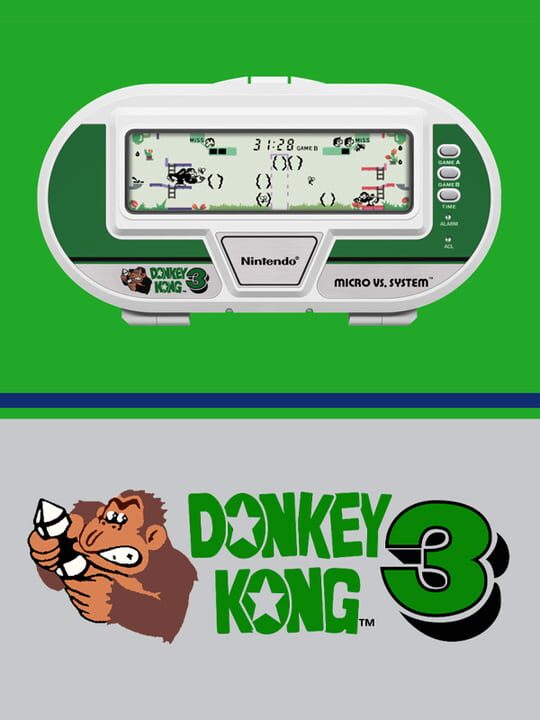
Donkey Kong 3
Overview:|
As a 1984 Micro VS. Game & Watch port, Donkey Kong 3 offers a distinct, dedicated two-player competitive experience, separate from its arcade namesake. Gameplay centers on direct opposition where one player controls Stanley and the other controls Donkey Kong. This release is notable as one of only three multiplayer titles in the Game & Watch line, emphasizing immediate, head-to-head arcade action on specialized handheld hardware.
This title, released in August 1984, is a unique entry within the broader franchise, specifically presented as a Micro VS. Game & Watch release. It is important to note that despite sharing a name with an arcade title, this version offers an entirely distinct gameplay experience tailored for the handheld format. As a port in this context, it adapts core concepts into a dedicated, limited-screen environment characteristic of the Game & Watch line.
Core Experience and Platform Context
This specific release is one of only three multiplayer titles produced for the Game & Watch series, designated by the model number AK• 302, where "AK" signifies "Attack Kong." The core value proposition lies in its dedicated, two-player competitive format, contrasting with many single-player handheld experiences of the era. The atmosphere is purely arcade-focused, built around immediate, competitive action on a specialized handheld unit.
What makes this game unique in its series?
The defining feature of this 1984 handheld iteration is its built-in two-player functionality. Unlike most contemporaneous handhelds, this unit allows for direct competition between two individuals simultaneously.
Gameplay Mechanics
The gameplay centers around a direct confrontation between two distinct roles. One player assumes control of Stanley, while the other controls Donkey Kong. This setup dictates the entire structure of the interaction, focusing on direct opposition rather than a single player navigating obstacles against an AI opponent. The mechanics are designed to facilitate quick, head-to-head arcade sessions on the specialized hardware.
Content Availability
This specific Game & Watch release is a self-contained unit, manufactured in a limited run of 250,000 units worldwide.
Are there any expansions or downloadable content available?
No, this version of the game does not feature any downloadable content or expansions. It was released as a complete, standalone product. Furthermore, there is one known remake associated with this specific handheld design.
Game Details
Primary Name: Donkey Kong 3
Alternative Names:
Game & Watch: Donkey Kong 3 (Alternative title)
Type: Port
Part of: Donkey Kong 3
Series: Game & Watch: Micro Vs.
Developer: Nintendo
Publisher: Nintendo
Release Information
Release Date: Aug 20, 1984
Genres & Themes
Genres: Platform, Arcade
Themes: Action
Platforms
Game & Watch
Game Modes
Perspective: Side view
Player Modes: Offline Co-op, Multiplayer
Game Modes: Multiplayer



 Soren
Soren