
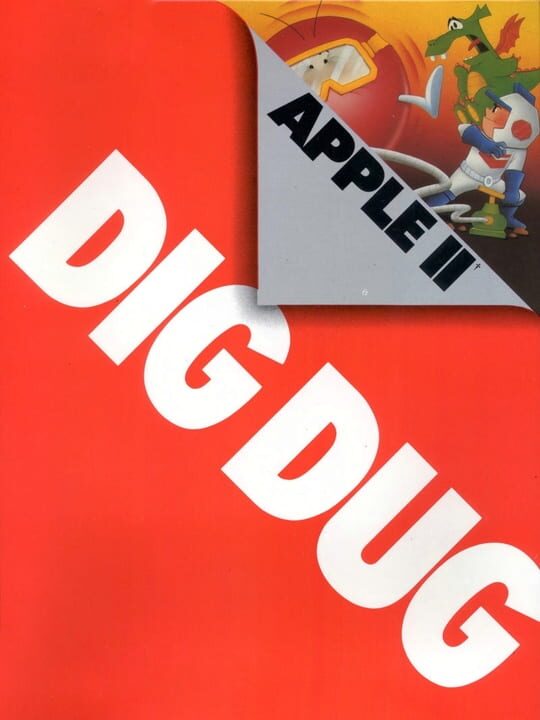
Dig Dug
Overview:|
As a classic arcade Port from 1984, Dig Dug challenges you to dig tunnels through the earth while avoiding Pooka and Fygar monsters. Your primary defense is an air pump to inflate enemies until they burst, or you can strategically drop rocks on them. A unique feature is that monsters become invincible ghosts if they lose sight of you, forcing constant movement. This version brings the core subterranean survival action to the Apple II platform.
This is a port of the classic 1984 arcade title, bringing subterranean survival action to the Apple II platform. The core experience centers around navigating an underground maze constructed entirely of earth, which you must actively dig yourself. Players are tasked with surviving relentless pursuit from two types of enemies while utilizing environmental traps and a unique inflation weapon to clear their path. This version maintains the original's focus on high-score chasing and tense, confined action.
Core Gameplay Loop: Digging and Defense
The fundamental activity involves using your shovel to carve tunnels through the dirt. This digging is crucial for creating pathways and positioning yourself advantageously against the pursuing monsters, Pooka and Fygar. Your primary offensive capability is the air pump.
To defeat enemies, you must attach the pump and inflate them until they explode. A critical mechanic here is commitment: if you stop inflating a monster before it reaches maximum capacity, it will deflate and immediately resume chasing you, often with renewed aggression.
Environmental Tactics and Hazards
Beyond direct confrontation, players can manipulate the environment for defense. Large, heavy rocks are scattered throughout the subterranean network. By digging out the earth directly beneath these rocks, you can cause them to fall, instantly crushing any monster caught in their path. Strategic rock placement and timing are essential for managing multiple threats simultaneously.
What happens when monsters cannot find the player?
A distinctive feature of the pursuit mechanic involves monster transformation. If Pooka and Fygar are unable to locate the player for a brief period, they will phase into an invincible ghost form. In this spectral state, they gain the ability to pass directly through solid earth, bypassing previously safe tunnels and forcing the player to constantly move and rethink their defensive positioning.
Game Structure and Content Value
The game is structured around score accumulation. In addition to eliminating monsters, bonus points are awarded when various types of vegetables appear and are collected from the center of the playfield.
As a port, this version delivers the complete, established arcade challenge on its target hardware. The original design supported up to two players, and this iteration retains that option, allowing for alternating turns or cooperative survival attempts.
Audience Appeal
This title appeals strongly to players who enjoy classic arcade mechanics, pattern recognition, and games that demand precise timing under pressure. Fans of maze navigation and resource management within a confined space will find the core loop engaging.
Game Details
Release Information
Release Date: Feb 1, 1984
Genres & Themes
Genres: Arcade
Themes: Action
Platforms
Apple II
Game Modes
Perspective: Side view
Player Modes: Single-player
Game Modes: Single player
Videos
No videos available for this game.
 Soren
Soren