
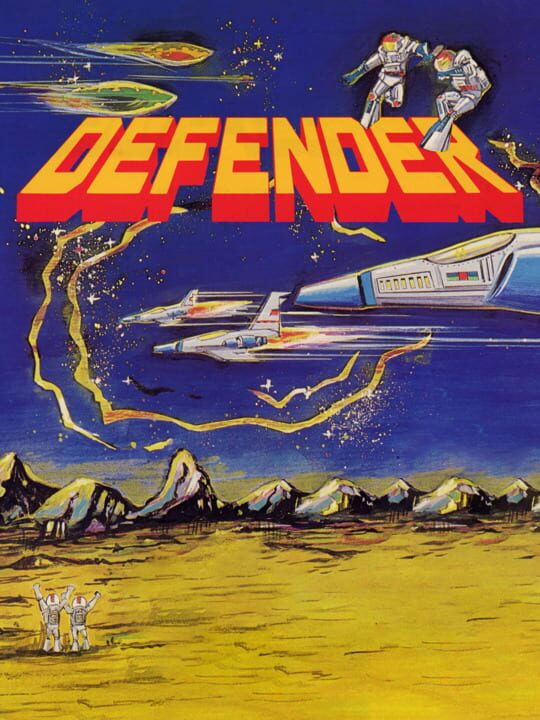
Defender
Overview:|
As a 1983 Port of a classic arcade Shooter, this title challenges you to pilot a ship across a single, continuous screen on the Apple II. Your core loop involves defending astronauts from alien abduction while simultaneously destroying hostile forces. Distinctive features include the dual threat of protecting human life and managing the risk of hyperspace jumps, which offer escape but can randomly reposition you in danger. This version delivers the intense, reflex-based action of the original design adapted for home computing.
This title, released in 1983, is a port of a well-regarded arcade experience, bringing the core action to the Apple II platform. As a shooter, it places the player in a high-stakes, side-scrolling environment where survival depends on quick reflexes and strategic maneuvering. The atmosphere is defined by constant threat, requiring players to manage multiple dangers simultaneously across a single, continuous screen.
Core Gameplay and Mechanics
The fundamental objective revolves around protecting astronauts from alien abduction while simultaneously defending the planet's surface from hostile forces. Players pilot a spacecraft capable of moving horizontally across the screen and thrusting vertically. A key mechanical feature is the ability to reverse direction instantly, which is crucial for navigating the chaotic battlefield and engaging enemies approaching from either side.
Weapons systems include a primary laser for destroying incoming enemies. However, the game introduces a significant strategic element: the ability to transform the ship into a hyperspace jump. While this offers a momentary escape from overwhelming situations, it carries the inherent risk of instantly reappearing in a random, potentially dangerous location on the screen.
What makes this game unique in the Shooter Genre?
The defining characteristic of this experience is the dual threat management system. Players are not just focused on shooting; they must actively prevent humanoid figures—the planet's inhabitants—from being captured by enemy ships. If an alien successfully abducts a human, that alien transforms into a more dangerous variant, often capable of mimicking the player's own ship or possessing enhanced weaponry.
Furthermore, the game features a unique degradation mechanic. If the player fails to rescue enough humans, the planet's surface itself can be destroyed, leading to a swift end to the current run. This layered objective structure elevates the challenge beyond simple target elimination.
Platform and Content Availability
This specific version was published for the Apple II in late 1983. As a direct port, it aims to replicate the intensity of the original arcade presentation within the constraints of the home computer hardware of that era.
Is there any additional content for this release?
This release is self-contained. There are currently no recorded downloadable content packs, expansions, remakes, or remasters associated with this specific 1983 Apple II port.
How does the Port classification affect the experience?
Being a port means the primary value proposition lies in experiencing a recognized, established arcade formula on a home system. The core challenge, the control scheme adaptation, and the visual presentation are all translated versions of the original design, offering a historical snapshot of early 1980s arcade action adapted for personal computing.
Game Details
Release Information
Release Date: Dec 31, 1983
Genres & Themes
Genres: Shooter
Themes: Science fiction
Platforms
Apple II
Game Modes
Perspective: Side view
Player Modes: Single-player
Game Modes: Single player
Videos
No videos available for this game.
 Soren
Soren