
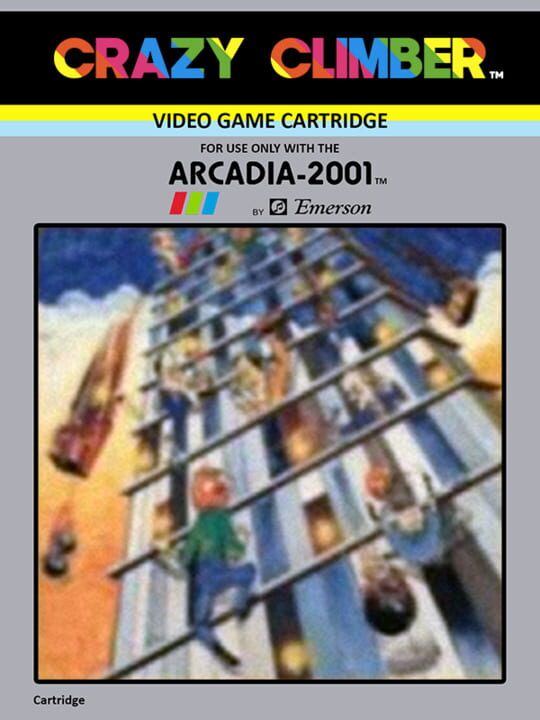
Crazy Climber
Overview:|
As a 1982 arcade port to the Arcadia 2001, Crazy Climber offers a pure, vertical challenge where you must scale buildings to meet a helicopter. Gameplay focuses entirely on precise upward and sideways movement; you cannot climb down. The core hazard involves timing your grips to avoid having your hands crushed by closing windows, which results in a fatal fall. Success relies on mastering the rhythm of these moving obstacles to chase high scores, with extra lives awarded periodically.
This title, originally released in 1982, is presented here as a Port, bringing the focused, vertical challenge of the classic arcade experience to the Arcadia 2001 platform. As a port, the primary value proposition is replicating the core mechanics of its source material, offering players a direct test of precision movement and timing against environmental hazards.
Core Gameplay Loop: The Vertical Ascent
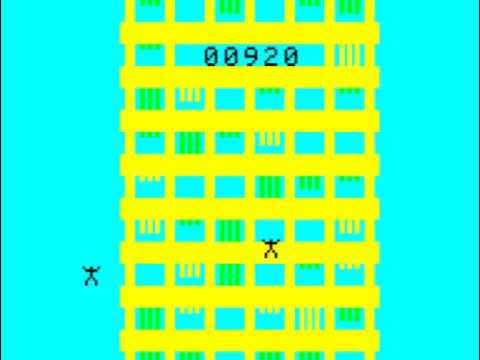
In this game, you assume the role of a dedicated climber whose objective is to scale a series of increasingly tall buildings. The ascent is strictly upward; players can move vertically or horizontally across the building's facade, but downward movement is not an option once a grip is established higher up the structure.
The immediate goal upon reaching the summit of each structure is to be picked up by a waiting helicopter, which then transports the climber to the next challenge. The entire experience is built around maintaining momentum while navigating hazards.
What are the primary hazards faced during climbing?
The environment itself is the main antagonist. The exterior of the buildings features windows that open and close in a synchronized pattern. Players must time their hand placement precisely to avoid being crushed:
- If a closing window traps only one of the climber's hands, the grip is lost, resulting in a slip down the structure.
- If a window closes simultaneously on both hands, the climber falls completely, resulting in the loss of a life.
Players begin the game with a limited supply of three lives. The system rewards sustained performance, as an extra life is granted every time the player achieves 30,000 points.
Audience Appeal and Experience
This game delivers a pure, high-score-chasing experience characteristic of early arcade titles. It appeals to players who enjoy immediate action, mastering rhythmic patterns, and overcoming escalating difficulty through mechanical skill rather than narrative progression or exploration.
As this specific version is a port of a 1982 arcade game, the content is self-contained. There are no associated downloadable content packs, expansions, or later remasters tied to this particular release on the Arcadia 2001 platform.
Game Details
Primary Name: Crazy Climber
Alternative Names:
Crazy Wall (Alternative title)
疯狂攀爬者 (Chinese title - simplified)
Type: Port
Part of: Crazy Climber
Series: Crazy Climber
Developer: Nichibutsu
Publisher: Grandstand
Release Information
Release Date: Jun 1, 1982
Genres & Themes
Genres: Arcade
Themes: Action
Platforms
Arcadia 2001
Game Modes
Perspective: Side view
Player Modes: Single-player
Game Modes: Single player
 Soren
Soren