
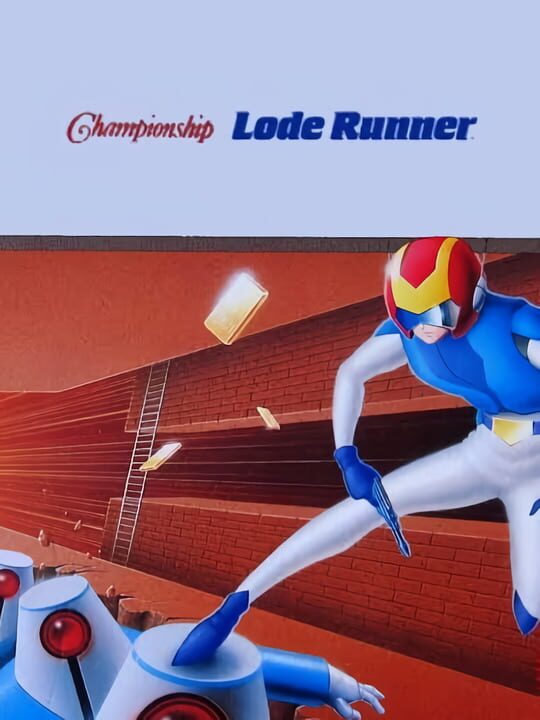
Championship Lode Runner
Port
RELEASED
Apr 20, 1985
Wii UFamily Computer+1byBrøderbund Software•Konami
Part of: Championship Lode Runner
Overview:|
As a port of a classic 1985 platform title, Championship Lode Runner challenges players to navigate single-screen levels to collect all scattered gold while evading robotic enemies. The core loop involves precise movement and tactical terrain manipulation: you must dig holes to temporarily trap foes, allowing safe passage or collection. Success relies on mastering timing and resource management within these maze-like structures, distinguishing it from continuous-scrolling platformers by focusing on puzzle-solving within fixed environments.
This title is a port of a classic platform experience, originally released in 1985. As a platform game, its core appeal lies in precise movement, timing, and environmental puzzle-solving across various stages. This version brings the established mechanics of its predecessor to new audiences on platforms such as the Wii U and the Family Computer.
Core Gameplay Mechanics
The central objective involves navigating intricate, single-screen levels to collect all the gold scattered throughout the environment. Players control a character tasked with outmaneuvering robotic enemies that patrol the maze-like structures. A key mechanic involves digging holes in the ground beneath these enemies. If an enemy falls into a freshly dug pit, they are temporarily incapacitated, allowing the player to proceed or collect necessary items.
The environment itself is highly interactive. Digging strategically is crucial not only for defense but also for manipulating the level layout to reach otherwise inaccessible gold. Players must manage their digging actions carefully, as the ground will eventually refill, potentially trapping the player or allowing enemies to recover.
What makes this game unique in the platform genre?
Unlike many contemporary platformers focused on continuous scrolling or combat, this game emphasizes single-screen tactical navigation and resource management—specifically, the management of the terrain itself. Success hinges on understanding enemy patrol patterns and using the digging mechanic as both an offensive and defensive tool to clear paths and secure collectibles.
Setting and Atmosphere
The atmosphere is defined by its arcade roots: bright, structured levels set against a backdrop that emphasizes clear visual communication of hazards and objectives. The setting is purely mechanical and puzzle-oriented, prioritizing clear gameplay challenges over deep narrative immersion.
Content Availability and Platform Context
This specific release is presented as a standalone port, meaning it delivers the core experience of the original design. There are currently no listed downloadable content packs, expansions, or additional content available for this version.
Platform Availability
This version of the game was made available on the Family Computer, and later ported for play on the Wii U.
Game Details
Primary Name: Championship Lode Runner
Type: Port
Part of: Championship Lode Runner
Series: Lode Runner
Developer: Brøderbund Software
Publisher: Konami, Hudson Soft
Release Information
Release Date: Apr 20, 1985
Genres & Themes
Genres: Platform
Themes: Action
Platforms
Wii UFamily ComputerWii
Game Modes
Perspective: Side view
Player Modes: Single-player
Game Modes: Single player
Age Ratings
CERO:A (All Ages)
Videos
No videos available for this game.
 Soren
Soren