
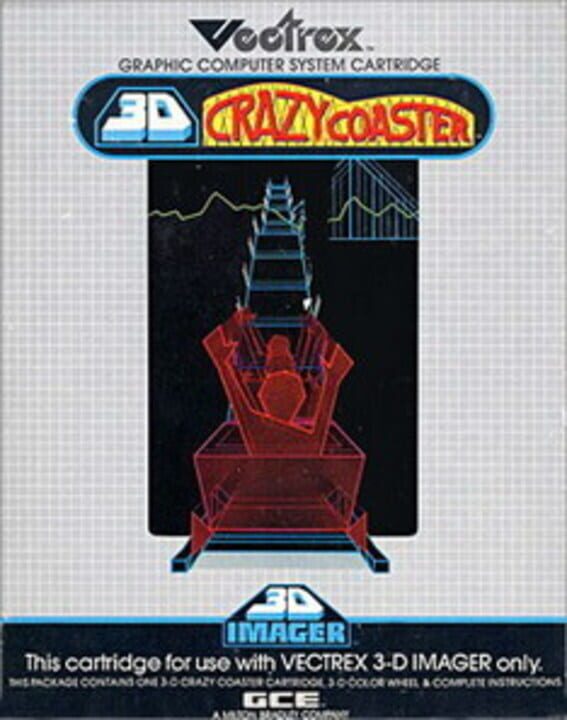
3D Crazy Coaster
Main Game
RELEASED
May 5, 1983
VectrexbyGCE•Milton Bradley
Overview:|
As a 1983 simulator/adventure main game, 3D Crazy Coaster challenges you to control the passenger in the lead car of an extreme roller coaster. The core loop involves navigating steep hills and gravity-defying curves while managing the passenger's stability, specifically ensuring their arms remain raised during intense maneuvers to prevent them from being ejected from the ride.
This title, originally launched in 1983 on the Vectrex platform, falls under the genres of Simulator and Adventure. It offers a focused experience centered entirely on the mechanics and thrills of a high-speed roller coaster simulation.
Core Gameplay Loop and Mechanics
The central objective requires the player to directly control the movements of the passenger seated in the lead car of the coaster. You are tasked with guiding this passenger through an extremely challenging track layout featuring both spectacularly steep hills and sharp, gravity-defying curves.
The primary challenge is maintaining passenger stability during the intense forces exerted by the ride. Specifically, the core mechanic involves successfully keeping the passenger's arms raised throughout the duration of the ride's most violent sections. If control is lost during these critical moments, the passenger will be ejected from the car, ending the run.
What is the distinctive feature of this simulation?
The game emphasizes precise, moment-to-moment reaction time against the physics of acceleration and gravity. It is a test of timing as the vehicle careens through the course, demanding constant input to counteract the forces attempting to dislodge the rider.
Game Content and Availability Status
As a main game release from its initial debut, this experience is presented as a complete, standalone product. There is no recorded information indicating the existence of downloadable content (DLCs), expansions, or subsequent remasters associated with this specific version.
Atmosphere and Setting
The setting is confined to the experience of the roller coaster itself. The adventure aspect is derived from surviving the perilous, high-stakes track design intended to push the limits of the ride vehicle and its occupant.
Platform Context
This simulation was developed for the Vectrex system, published by Milton Bradley and developed by GCE.
Game Details
Primary Name: 3D Crazy Coaster
Type: Main Game
Developer: GCE
Publisher: Milton Bradley
Release Information
Release Date: May 5, 1983
Genres & Themes
Genres: Simulator, Adventure
Platforms
Vectrex
Game Modes
Perspective: First person
Player Modes: Single-player
Game Modes: Single player
Videos
No videos available for this game.
 Soren
Soren