
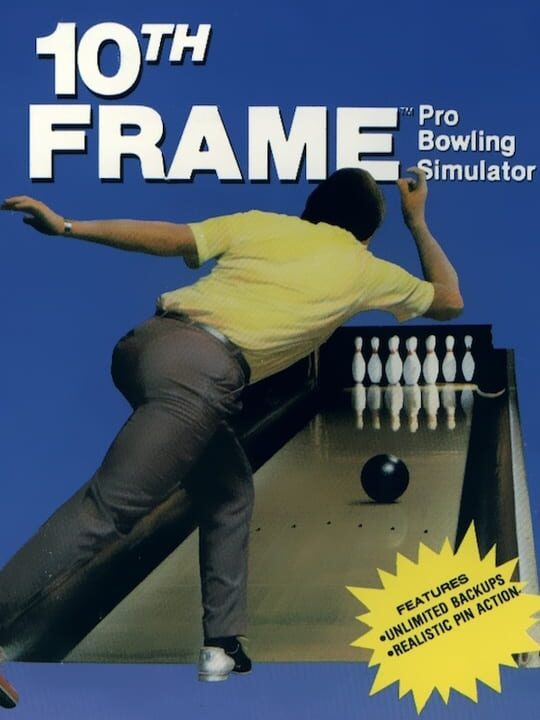
10th Frame
Main Game
RELEASED
Dec 31, 1986
DOSCommodore C64/128/MAX+4byAccess Software•US Gold Ltd
Overview:|
As a dedicated sports simulation from 1986, 10th Frame focuses entirely on the mechanics of ten-pin bowling across platforms like DOS and Commodore systems. You engage in core bowling action, controlling approach and release to score, with modes including casual Open Play and structured League competition for up to eight players. Its appeal rests in offering a comprehensive, multi-player digital interpretation of the sport prevalent during that era, prioritizing physics simulation over narrative.
This title, released in late 1986, is a dedicated sports simulation focusing entirely on the classic game of ten-pin bowling. Designed for a variety of early home computer systems, including DOS, Commodore C64/128, ZX Spectrum, MSX, Amstrad CPC, and Atari ST/STE, it aims to replicate the experience of stepping up to the lane for a serious game. The atmosphere is centered purely on the mechanics of the sport itself, offering a straightforward digital interpretation of bowling alleys popular during that era.
Core Gameplay and Mechanics
The central experience revolves around accurate ball control and pin physics simulation. Players engage in standard bowling rules, managing their approach, swing, and release to achieve strikes and spares. The primary gameplay loop involves selecting the type of ball, adjusting the angle of delivery, and controlling the power applied to the throw.
Available Game Structures
The simulation offers two primary ways to compete, catering to different play styles:
- Open Bowling Mode: This allows for casual, one-off games where players can immediately jump into the action.
- League Mode: This mode introduces structure, allowing players to compete across a series of matches, simulating a full bowling league season with ongoing progression.
Player Configuration and Competition
The simulation supports local multiplayer interaction for up to eight participants, making it suitable for group sessions. Furthermore, to accommodate varying skill levels, several difficulty settings are integrated into the simulation, allowing players to adjust the challenge presented by the lane conditions or pin action.
What defines the experience of this 1980s simulation?
While the visual presentation reflects the technological limitations of its release year, the game's enduring appeal lies in its commitment to providing a comprehensive, multi-player bowling simulation across a wide array of early computing platforms. It prioritizes the core mechanics of the sport over complex narrative or external features, delivering a focused digital recreation of ten-pin bowling.
Additional Content Availability
It is important to note that this is a standalone main game. There are no officially released downloadable content packs or expansions associated with this title.
Game Details
Primary Name: 10th Frame
Type: Main Game
Developer: Access Software
Publisher: US Gold Ltd, Access Software
Release Information
Release Date: Dec 31, 1986
Genres & Themes
Genres: Sport
Platforms
DOSCommodore C64/128/MAXZX SpectrumMSXAmstrad CPCAtari ST/STE
Game Modes
Perspective: Third person
Player Modes: Single-player
Game Modes: Single player, Multiplayer
Videos
No videos available for this game.
 Soren
Soren