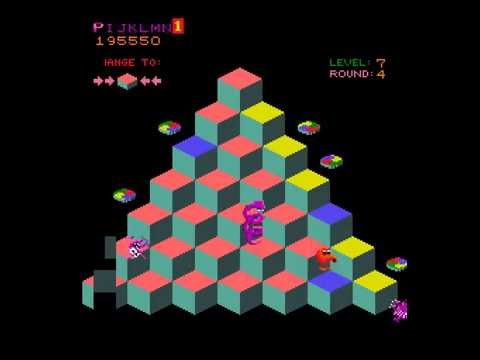
Q*bert, ett klassiskt arkadspel från 1982, är ett isometriskt plattforms-/pusselspel där du styr huvudkaraktären för att ändra färgen på varje kub i en pyramid genom att hoppa på dem. Spelet saknar djup handling och fokuserar på att undvika ständigt jagande fiender. Dess distinkta visuella stil, som skapar en illusion av 3D, var banbrytande. Spelet finns tillgängligt på plattformar som Arcade och PlayStation 3.
","tokens":{"input":2160,"output":125,"total":2285}}Rörelser utförs genom riktade hopp. Medan målet är enkelt – ändra alla färger – eskalerar utmaningen snabbt på grund av introduktionen av olika antagonistiska enheter som patrullerar strukturen.
\n\nSpelet är anmärkningsvärt för sin användning av isometrisk grafik för att skapa illusionen av ett tredimensionellt utrymme på ett tvådimensionellt plan. Denna visuella stil, som påminner om koncept som Penrose-trappan, definierade dess utseende och känsla, vilket skiljde det från samtida sidscrollande plattformsspel. Det fungerar i grunden som ett pusselspel där rumslig medvetenhet och tajming är avgörande för överlevnad.
\n\nFör att hindra spelaren från att enkelt slutföra målet introduceras flera typer av fiender. Dessa varelser jagar aktivt spelarkaraktären över kubernas ytor. Att framgångsrikt undvika eller neutralisera dessa hot samtidigt som man bibehåller framåtskridandet i färgbytet utgör den centrala spänningen i upplevelsen.
\n\nSpelet har en okomplicerad premiss utan någon djup narrativ struktur, vilket är typiskt för dess arkadursprung. Fokus ligger helt på att bemästra rörelsemekaniken och överleva de alltmer komplexa mönstren hos de fientliga enheterna.
\n\nSom ett klassiskt arkadspel har denna huvudversion inga officiella nedladdningsbara tillägg (DLC) eller expansioner släppta för denna version. Dock har konceptets bestående popularitet resulterat i flera efterföljande nyversioner genom åren.
\n\nDen ursprungliga iterationen av detta spel släpptes för arkadmaskiner. Modern tillgänglighet inkluderar portar som finns på plattformar som PlayStation 3.
","tokens":{"input":2352,"output":733,"total":3085}}
One of the most critically acclaimed and commercially successful arcade games of the 1980s is back in its Classic pixel perfect 2D form, and a re-imagined Reboot version with state of the art 3D game-play and graphics that remain faithful to the original concept.

Q*bert is a remake of the arcade game of the same name with three-dimensional (3D) graphics. It was developed by Artech Studios and released by Hasbro Interactive on the PlayStation and PC in 1999 and on the Dreamcast in 2000. Q*bert has 3 modes of play. Classic is like the original Q*bert, and the graphics can be changed from Retro to Modern. The Adventure mode takes Q*bert to 3D dimensions, and contains power ups and all new characters set in 4 worlds. Head to Head is a multiplayer mode.

Q*bert for Game Boy brings new challenges to the classic series.

NES port of Q*Bert.

Q*bert is a MSX game developed by Konami in 1986. Despite sharing the same name as the original, it has gameplay styled after Q*bert's Qubes. the title character being replaced by Wrappy (konami MSX research team mascot) that has draconic appearance with small eyes, a visible, expressive mouth, arms, purple skin, yellow spines, and a somewhat long tail.

Q*bert is an isometric platform game with puzzle elements where the player controls the titular protagonist from a third-person perspective. Q*bert starts each game at the top of a pyramid of cubes, and moves by jumping diagonally from cube to cube. Landing on a cube causes it to change color, and changing every cube to the target color allows the player to progress to the next stage.

Q*bert is an isometric platform game with puzzle elements where the player controls the titular protagonist from a third-person perspective. Q*bert starts each game at the top of a pyramid of cubes, and moves by jumping diagonally from cube to cube. Landing on a cube causes it to change color, and changing every cube to the target color allows the player to progress to the next stage.

Q*bert is an arcade game by Gottlieb. It was ported to the SG-1000 by Tsukuda Original, who marketed it for their Othello Multivision console. The objective of the game is to turn all the cubes on screen to a desired colour by moving Q*bert on top of them. Q*bert can only move in diagonals, and the player needs to be careful not to either send Q*bert off the edge or have him collide with enemies/obstacles. Occasionally cylindrical platforms appear on the edge of the screen, which when jumped on, will take Q*bert to the top. The SG-1000 port is a very bare-bones rendition of the game and is missing many elements seen in the arcade version. It is also much harder as the port sends out more enemies in the first few levels.

A handheld conversion of Q*Bert arcade game.

Q*bert is an isometric platform game with puzzle elements where the player controls the titular protagonist from a third-person perspective. Q*bert starts each game at the top of a pyramid of cubes, and moves by jumping diagonally from cube to cube. Landing on a cube causes it to change color, and changing every cube to the target color allows the player to progress to the next stage.

Q*bert is an isometric platform game with puzzle elements where the player controls the titular protagonist from a third-person perspective. Q*bert starts each game at the top of a pyramid of cubes, and moves by jumping diagonally from cube to cube. Landing on a cube causes it to change color, and changing every cube to the target color allows the player to progress to the next stage.

A handheld conversion of Q*Bert arcade game.

Q*bert is an isometric platform game with puzzle elements where the player controls the titular protagonist from a third-person perspective. Q*bert starts each game at the top of a pyramid of cubes, and moves by jumping diagonally from cube to cube. Landing on a cube causes it to change color, and changing every cube to the target color allows the player to progress to the next stage.

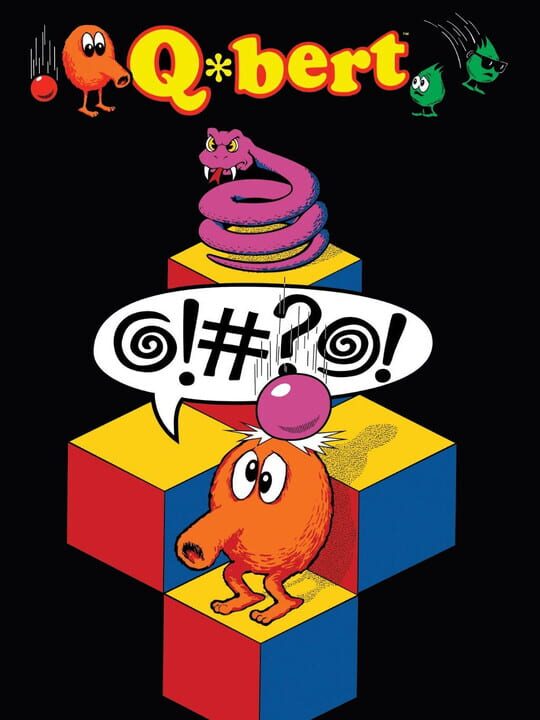
Q*bert is a popular arcade game. The goal is to change all of the tiles on a pyramid to the target color. To do this you guide Q*bert around the pyramid, and every tile he hops on will change color. On early levels, a single hop will change the tile to the desired color, but on later levels, you may need to hop on a tile multiple times or even avoid hopping on a tile multiple times! Trying to stop Q*bert are many different creatures wandering around the board, including Coily the snake, Slick and Sam, and falling balls. On the edge of the board are floating discs; if Q*bert jumps on one of these discs when the snake is in pursuit, the snake will fall off the board while Q*bert is safely transported to the top.

Q*bert is a popular arcade game. The goal is to change all of the tiles on a pyramid to the target color. To do this you guide Q*bert around the pyramid, and every tile he hops on will change color. On early levels, a single hop will change the tile to the desired color, but on later levels you may need to hop on a tile multiple times or even avoid hopping on a tile multiple times! Trying to stop Q*bert are many different creatures which wander around the board, including Coily the snake, Slick and Sam, and falling balls. On the edge of the board are floating discs; if Q*bert jumps on one of these discs when the snake is in pursuit, the snake will fall off the board while Q*bert is safely transported to the top.

A handheld conversion of Gottlieb's Q*Bert arcade game.

All the action and excitement of the popular arcade game are here! Hop Q*bert up and down a pyramid of cubes, changing colors on each of the cube tops. When they're all the same color, Q*bert moves to a new - and more difficult - pyramid. But strange characters want to stop Q*bert from his fanciful mission. You'll have to do some fast hopping in this quick and "quasy" game! 1 or 2 players.

Q*bert is an isometric platform game with puzzle elements where the player controls the titular protagonist from a third-person perspective. Q*bert starts each game at the top of a pyramid of cubes, and moves by jumping diagonally from cube to cube. Landing on a cube causes it to change color, and changing every cube to the target color allows the player to progress to the next stage.