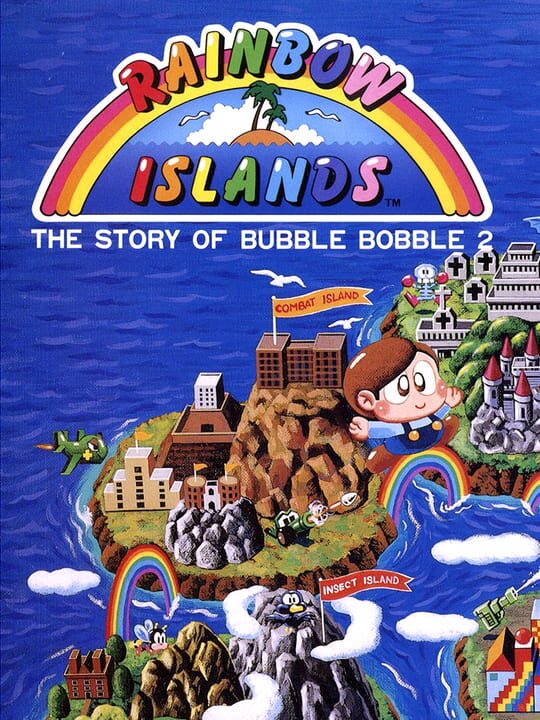
Rainbow Islands: The Story of Bubble Bobble 2
Main Game
RELEASED
7.7
31. Dez. 1987
Turbografx-16/PC Engine CDPC (Microsoft Windows)+7byTaito•NEC Avenue
Übersicht:|
{"overview":"
Als klassischer Arcade-Platformer mit Puzzle-Elementen, ursprünglich 1987 veröffentlicht, setzt Rainbow Islands: The Story of Bubble Bobble 2 die Geschichte fort: Ihr müsst die Bewohner der Inseln, die in Drachen verwandelt wurden, retten, indem ihr Edelsteine und Spiegel sammelt. Das Gameplay dreht sich um das Fangen von Gegnern in Blasen und deren anschließendes Platzen, wobei die Nutzung von Regenbogen-Magie für den Fortschritt entscheidend ist. Das Spiel ist auf vielen klassischen Plattformen wie Amiga, C64 und Arcade verfügbar und erhielt eine Remaster-Version.
","tokens":{"input":2481,"output":141,"total":2622}}{"overview":"
\nDieses Spiel, untertitelt als \"The Story of Bubble Bobble 2\", ist ein klassisches Arcade-Plattform- und Puzzlespiel, das ursprünglich im Jahr 1987 veröffentlicht wurde. Es stellt die direkte Fortsetzung des Hits des Vorjahres dar und setzt das Abenteuer in einer lebendigen, farbenfrohen Welt fort. Spieler begeben sich auf eine Queste quer über die titelgebenden Inseln, um eine magische Verwandlung der lokalen Bewohner rückgängig zu machen. Das Spiel wurde auf zahlreichen Heimcomputern und Konsolen portiert, darunter der Commodore C64, Amiga, Atari ST und das TurboGrafx-16/PC Engine.\n
\n\nDie Prämisse und das Setting
\nDie Handlung dreht sich um zwei Protagonisten, die sich aufmachen, um die Bewohner der Regenbogeninseln zu retten. Diese Inselbewohner wurden durch den bösen Boss of Shadow in Blasen-Drachen verwandelt. Um alle wieder in ihren normalen Zustand zurückzuversetzen, müssen die Helden die zehn unterschiedlichen Regenbogeninseln durchqueren. Dabei sammeln sie wichtige große Edelsteine und Spiegel, die über die Level verteilt sind, bevor sie sich dem finalen Antagonisten stellen.
\n\nKern-Gameplay-Mechaniken
\nAls Plattformer mit starken Puzzle-Elementen beinhaltet die Spielschleife das Navigieren durch Level voller Gegner und Hindernisse. Eine zentrale Mechanik ist die Nutzung einer einzigartigen Methode, um Widersacher festzusetzen. Anstatt direkter Angriffe müssen Spieler Gegner in temporäre Blasen einschließen. Sobald ein Gegner eingesperrt ist, muss der Spieler die Blase platzen lassen, oft durch daraufspringen oder durch Interaktion mit der Umgebung, um die Bedrohung zu beseitigen.
\n\nEin wichtiges Merkmal, das diesen Nachfolger auszeichnet, ist die Einführung der Regenbogenmagie. Das erfolgreiche Abschließen von Abschnitten und das Sammeln von Gegenständen führt oft zum Erscheinen von Regenbögen, die für den Spielfortschritt und die Punktzahl integral sind. Die Beherrschung des Timings und der Platzierung dieser Regenbogeneffekte ist entscheidend für den Erfolg.
\n\nWas macht dieses Spiel einzigartig im Plattformer-Genre?
\nDas Spiel verbindet schnelles Plattforming mit strategischer Blasenmanipulation und schafft so eine besondere Herausforderung, die sowohl schnelle Reflexe als auch überlegtes Positionieren erfordert. Das Fortschrittssystem ist direkt an das Sammeln mächtiger Artefakte – die großen Edelsteine und Spiegel – gebunden, die notwendig sind, um die Handlung über die verschiedenen Inselumgebungen hinweg voranzutreiben.
\n\nInhaltsverfügbarkeit
\nDieses Hauptspielerlebnis wird ohne zusätzliche herunterladbare Inhalte (DLCs) oder Erweiterungen angeboten. Obwohl seit der ursprünglichen Veröffentlichung ein Remaster erschienen ist, bleibt der Kerninhalt konsistent mit der ursprünglichen Arcade-Version von 1987.
\n\nPlattform-Verfügbarkeit
\nDieser Titel weist eine breite historische Präsenz auf und erschien auf Plattformen wie Arcade, ZX Spectrum, Amstrad CPC, Commodore C64/128/MAX, Amiga, Atari ST/STE und dem TurboGrafx-16/PC Engine, einschließlich einer CD-ROM-Version für letzteres System. Es wurde auch für PC (Microsoft Windows) bereitgestellt.
","tokens":{"input":2673,"output":782,"total":3455}}Game Details
Primary Name: Rainbow Islands: The Story of Bubble Bobble 2
Alternative Names:
Bubble Bobble 2 (Alternative title)
Rainbow Islands (Japanese title - translated)
Rainbow Islands: Story of Bubble Bobble II (Alternative spelling)
Type: Main Game
Series: Rainbow Islands
Developer: Taito
Publisher: NEC Avenue, MediaKite Distribution, Taito, Romstar
Release Information
Release Date: Dez. 31, 1987
Genres & Themes
Genres: Platform, Puzzle, Arcade
Themes: Action, Fantasy
Platforms
Turbografx-16/PC Engine CDPC (Microsoft Windows)Commodore C64/128/MAXTurboGrafx-16/PC EngineZX SpectrumAmigaAmstrad CPCArcadeAtari ST/STE
Game Modes
Perspective: Side view
Player Modes: Single-player
Game Modes: Single player, Multiplayer

 Soren
Soren